Section
Types of Espresso Machines: Who Does the Work, and How the Water Gets Hot
By EspressoGoods editors · Updated 2026-11-09 · How we research
We may earn a commission when you buy through links on this page.
Short answer
There are five types of espresso machines by who does the work: manual lever (you make the pressure), semi-automatic (you grind, dose and tamp; a pump makes the pressure), semi-automatic with a built-in grinder, super-automatic (beans in, drink out) and portable hand-pumped. Separately, each is heated by a thermoblock, a single boiler, a heat exchanger or a dual boiler.
Ask what the types of espresso machines are and you will usually get three words: manual, semi-automatic, automatic. That answers only half the question. Every machine can be sorted on two separate axes, and the diagram table below shows both: first, who does each step (grinding, dosing, tamping, starting and stopping the shot, steaming milk); second, how the water gets hot (a flow-through thermoblock, one boiler, a heat exchanger or two boilers).
The first axis decides how much work you do each morning. The second decides whether you can steam milk while a shot pulls, and how long you wait. A Breville Dual Boiler and a Breville Bambino are both semi-automatic, yet they sit at opposite ends of the heating axis. A Ninja Luxe Café and a De'Longhi Magnifica both grind for you, yet only one asks you to lock in a portafilter.
The counts and prices on this page come from our catalogue of 45 home machines, built from makers' own spec pages on 9 November 2026. They describe what is on sale, not a ranking.
One example of each type from our catalogue
1. Manual lever
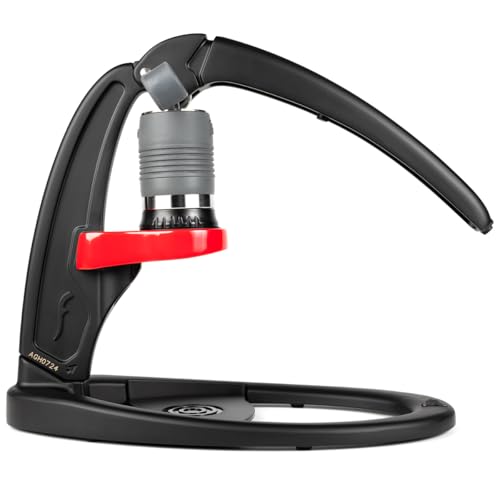
Flair Classic
Flair calls it 100% human-powered with no plugs or electronics. You heat water in a kettle, pour 60 ml into the cylinder and press the lever; a gauge marks 9 bar. The portafilter is 40 mm.
Buy it if: Straight espresso on a small budget, or away from an outlet. Skip it if: You drink milk drinks: there is no steam wand.
- Type
- Manual lever
- Heating
- No heater (manual)
- Portafilter
- 40 mm
- Milk
- none
- Water tank
- Input Water Capacity – 60ml
- Size (W×D×H)
- 12.5" L x 6.25" W x 10" H (assembled)
- Weight
- 5 lb
Specs: Flair Espresso US product page (2026-11-09); Flair listing on Amazon (2026-11-09)
2. Semi-automatic
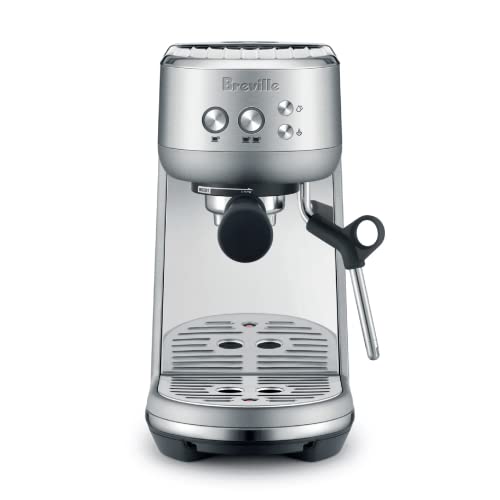
Breville Bambino
Breville lists a ThermoJet heater ready in 3 seconds, PID control, a 54 mm portafilter and single and dual wall baskets. You grind, dose and tamp; the pump does the rest.
Buy it if: Learning espresso with a separate grinder. Skip it if: You will not buy a grinder and want everything in one box.
- Type
- Semi-automatic
- Heating
- ThermoJet
- PID
- Yes
- Portafilter
- 54 mm
- Milk
- steam wand (manual milk texturing)
- Heat-up (maker)
- ready to start in 3 seconds
- Water tank
- 47 fl.oz
- Size (W×D×H)
- 7.7 x 12.6 x 12.2 in (W x D x H, Breville listing on Amazon)
- Weight
- 10.42 lb
Specs: Breville US product page (2026-11-09); Breville listing on Amazon (2026-11-09)
3. Semi-automatic with grinder
Breville Barista Express
An integrated conical burr grinder with 16 settings, a Thermocoil heater with PID, a pressure gauge and a manual steam wand, all in one body that Breville lists at 15.9 in tall.
Buy it if: One purchase, one footprint, and you still tamp and time the shot. Skip it if: Headroom is tight: Breville lists it at 15.9 in tall, against 12.2 in for a Bambino.
- Type
- Semi-automatic
- Heating
- Thermocoil
- PID
- Yes
- Grinder
- integrated conical burr grinder, steel conical burrs, 16 precision grind settings
- Portafilter
- 54 mm
- Milk
- steam wand (manual milk texturing)
- Water tank
- 67 oz; bean hopper 1/2 lb
- Size (W×D×H)
- 15.9 x 13.1 x 12.4 in as printed on Breville's page; Breville's own Amazon listing gives a 15.9 in height, so the page's first figure is the height and its W×D labelling can't be relied on
- Weight
- 22.09 lb
Specs: Breville US product page (2026-11-09); Breville listing on Amazon (2026-11-09)
4. Super-automatic
De'Longhi Magnifica Evo (LatteCrema)
De'Longhi lists a 13-setting conical burr grinder, a LatteCrema milk carafe and seven one-touch drinks. You add beans, water and milk, then press a button.
Buy it if: Milk drinks at the push of a button. Skip it if: You want to adjust tamp or shot timing yourself.
- Type
- Super-automatic (bean to cup)
- Heating
- Thermoblock
- Grinder
- conical burr, 13 grind settings
- Milk
- LatteCrema System (automatic milk frother, carafe)
- Water tank
- 60.87 oz
- Size (W×D×H)
- 9.4 x 17.3 x 14.2 in (maker label: L x W x H)
- Weight
- 26.28 lb
Specs: De'Longhi US product page (2026-11-09); De'Longhi listing on Amazon (2026-11-09)
5. Dual boiler
Breville Dual Boiler
Two boilers, a PID-controlled espresso boiler, a 58 mm portafilter and dual 15 bar pumps that Breville says let you texture milk and pull a shot at once.
Buy it if: Several milk drinks back to back. Skip it if: You only drink straight espresso; the second boiler is for steam.
- Type
- Semi-automatic
- Heating
- dual boiler
- PID
- Yes
- Portafilter
- 58 mm
- Milk
- steam wand (powerful manual milk texturing)
- Water tank
- 84 oz
- Size (W×D×H)
- 37.9 x 40.3 x 37.1 cm (W x D x H)
- Weight
- 28.35 lb
Specs: Breville US product page (2026-11-09); Breville listing on Amazon (2026-11-09)
6. Portable
Wacaco Minipresso GR
Wacaco says it needs no battery or electricity: add ground coffee and boiling water, then pump a few strokes. It makes up to 50 ml.
Buy it if: Travel, camping and the office. Skip it if: You want a home machine; Wacaco does not state its pressure.
- Type
- Portable
- Heating
- No heater (manual)
- Milk
- none
- Weight
- 0.79 lb
Specs: Wacaco listing on Amazon (2026-11-09)



Product prices and availability are accurate as of 2026-11-13 and are subject to change. Amazon prices are for the colour linked. Specs are the makers' published figures; we don't test machines.
Find the espresso machines that fit you
Answer what matters; leave the rest on “Any”. Matching uses only the makers' published specs and today's prices.
Wacaco Minipresso GR
Portable · No heater
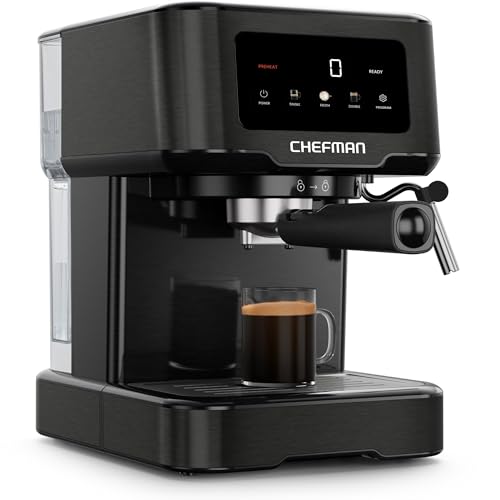
Chefman CraftBrew Espresso Machine
Semi-automatic · 8.9 in wide
CASABREWS 3700 Essential
Semi-automatic · Flash heater · 51 mm
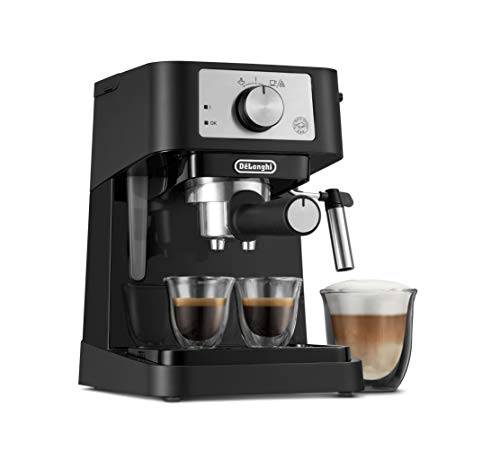
De'Longhi Stilosa
Semi-automatic · Single boiler · 8.07 in wide
CASABREWS CM5418
Semi-automatic · Flash heater · 51 mm
De'Longhi Classic (sold on Amazon as Classic Signature)
Semi-automatic · Flash heater · 9 in wide
Flair Classic
Manual lever · No heater · 40 mm · 6.25 in wide
CASABREWS 5418 PRO
Semi-automatic · Flash heater · 5.9 in wide
CASABREWS Ultra
Semi-automatic · Flash heater · 58 mm · 10.31 in wide
Breville Bambino
Semi-automatic · Flash heater · 54 mm · 7.7 in wide
CASABREWS Marenza
Semi-automatic · Flash heater · 58 mm · 8.9 in wide
Flair 49 PRO
Manual lever · No heater · 49 mm · 7.5 in wide



Showing the 12 lowest-priced matches. Narrow an answer, or open the compare tab to see all of them.
Specs are each maker's published figures (source linked per machine). Amazon prices as of 2026-11-13; prices change. We earn from qualifying purchases; it never affects matching or order, which is lowest price first.
The diagram: who does each step on each type
Read across a row to see what a type of machine takes off your hands. 'You' means a manual step every time you make a drink. 'Machine' means the maker says the machine does it. 'Assisted' means the machine helps (a guided grind, a lever that tamps) but you still handle the portafilter.
| Type | Grind | Dose & tamp | Make pressure | Start & stop shot | Steam milk | Example |
|---|---|---|---|---|---|---|
| Manual lever | You (separate grinder) | You | You (lever) | You | No wand (Flair) | Flair Classic |
| Semi-automatic | You (separate grinder) | You | Pump | You, or preset buttons | You (wand) or auto wand | Breville Bambino |
| Semi-automatic with grinder | Built-in grinder | You | Pump | You, or preset buttons | You (wand) or auto wand | Breville Barista Express |
| Assisted semi-automatic | Built-in, guided | Assisted (lever or auto tamp) | Pump | Machine or you | Automatic system | Breville Oracle Jet, Ninja Luxe Café |
| Super-automatic | Machine | Machine (internal brew unit) | Pump | Machine | Carafe or frother | De'Longhi Magnifica Evo |
| Portable hand-pumped | You (pre-ground) | You | You (hand pump) | You | None | Wacaco Minipresso GR |
Manual lever: you are the pump
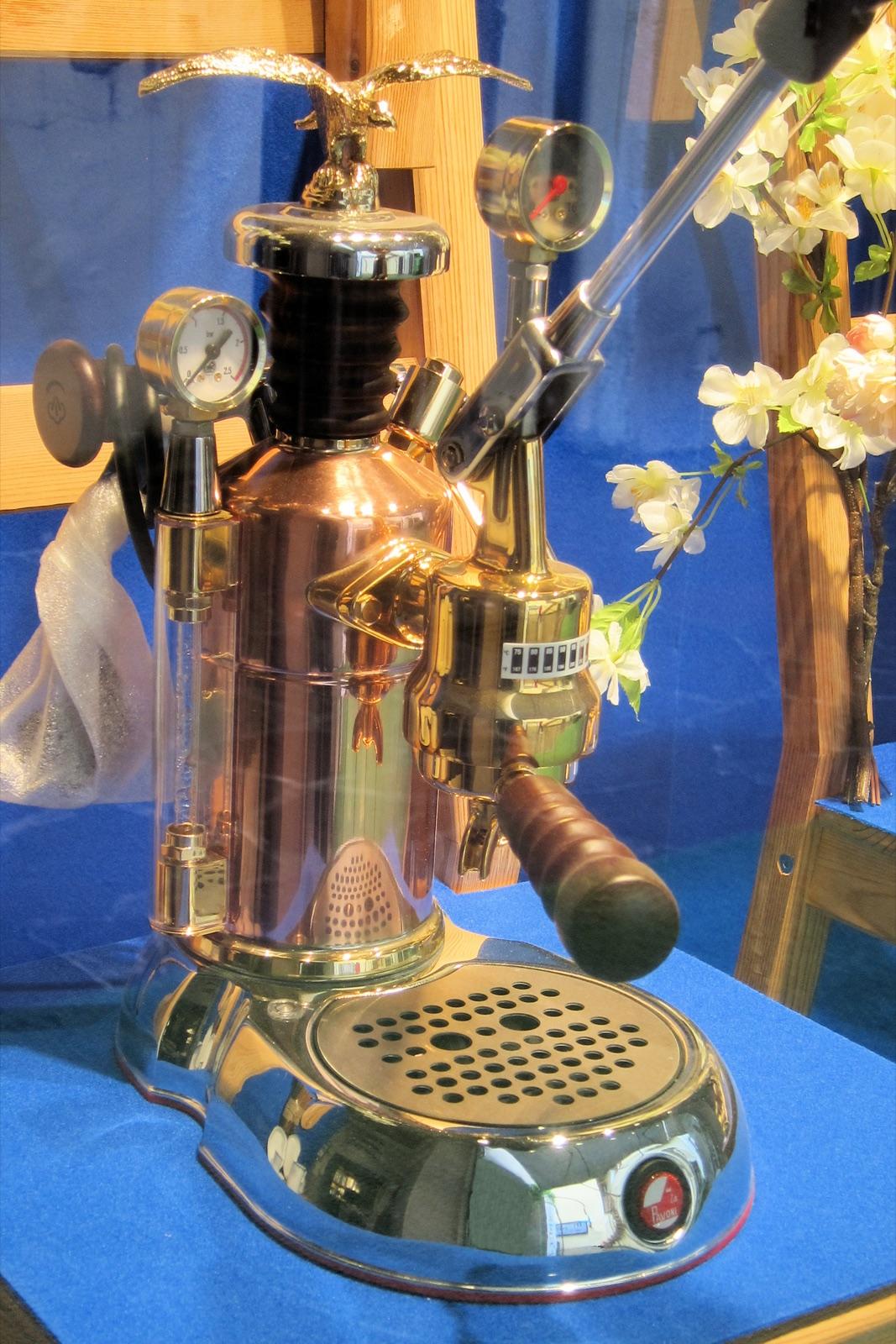
A lever machine has no pump. You pull or press a lever, and your arm forces hot water through the coffee. The La Pavoni in the photo above is a lever machine with its own gauges; the Flair presses in our catalogue do not heat anything at all. Flair says the Flair Classic is '100% human-powered' with 'no plugs or electronics', and its notes say to boil water in a kettle and pour it into the brewing cylinder.
That makes a lever press cheap and quiet, and it puts the pressure in your hands. The Flair Classic has a gauge that marks 9 bar, the pressure the Istituto Nazionale Espresso Italiano (INEI) gives for espresso. The Flair 49 PRO's gauge is marked 6 to 9 bar. The trade-off is volume and milk: the Classic takes 60 ml of water at a time, the 49 PRO 90 ml, and neither has a steam wand.
The Pavoni name on the machine in the photo goes back to the first espresso machines. Britannica records that Desiderio Pavoni bought Luigi Bezzera's 1902 patents, added a pressure-release valve and a steam wand, and showed the 'Ideale' machine with Bezzera at the 1906 World's Fair in Milan.
Semi-automatic: the pump does the pressure, you do the rest
This is the largest group in our catalogue, 19 machines without a grinder and 13 with one. A pump builds the pressure, the machine heats the water, and you handle everything to do with the coffee: grinding it in a separate grinder, dosing it into the basket, tamping, locking the portafilter in, and starting the shot. Many models add preset one-cup and two-cup buttons that stop the shot for you.
Semi-automatics span the widest price range of any type. In our catalogue the cheapest lists at about $110 (CASABREWS 3700 Essential) and the dearest at about $3,000 (Lelit Bianca). What changes as the price climbs is mostly the heating system, the portafilter size (51 mm and 54 mm at the low end, 58 mm higher up) and whether you can see and control temperature and pressure.
The basket matters as much as the machine. Breville's manuals say single wall baskets suit freshly ground beans, because they let you 'experiment with grind, dose and tamp', while dual wall baskets are for pre-ground coffee and 'regulate the pressure'. A semi-automatic sold only with pressurised baskets behaves more like a push-button machine than its type suggests.
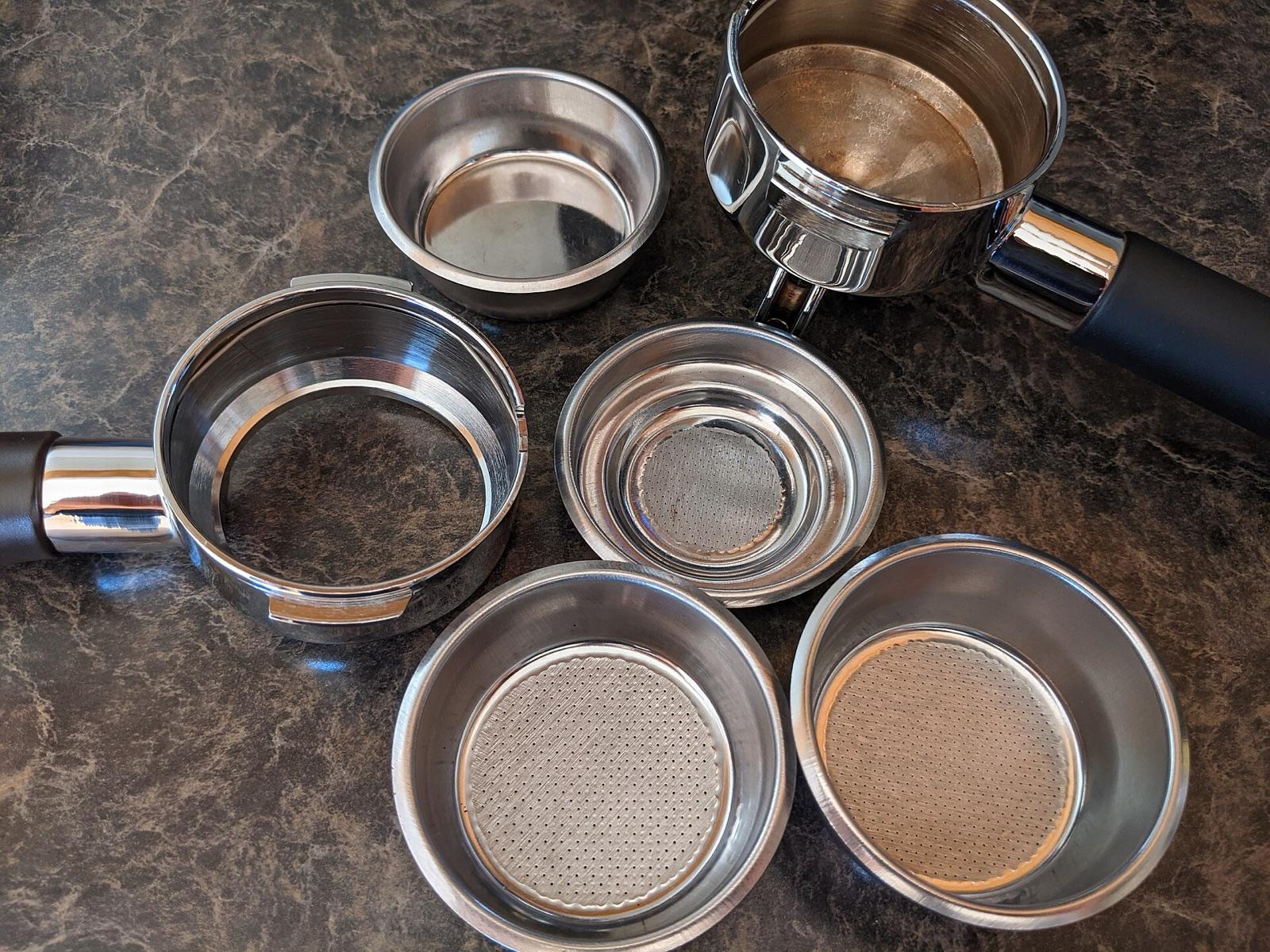
What changes when the grinder is built in?
A semi-automatic with a built-in grinder saves a second appliance and some counter space, and it removes one buying decision. The Breville Barista Express lists an integrated conical burr grinder with 16 settings; the Barista Pro has 30; De'Longhi's La Specialista models and the CASABREWS Marenza also grind on board. You still dose, tamp and lock in the portafilter yourself.
A newer branch goes further and helps with the hard steps. Breville says the Oracle Jet will 'auto grind, dose & tamp into a 58 mm portafilter'. Ninja describes 'Barista Assist Technology' on its Luxe Café machines with grind guidance and weight-based dosing, and an 'integrated tamper at the pull of a lever' on the Luxe Café Pro. De'Longhi's La Specialista Opera has 'Smart Tamping Technology'. These sit between semi-automatic and super-automatic: you still move the portafilter, but the machine decides more.
The cost of combining the two is flexibility. A built-in grinder cannot be upgraded on its own, and its range is set by the maker. A separate grinder can move with you to your next machine.
Super-automatic: beans in, drink out
A super-automatic grinds, doses, tamps inside a sealed brew unit, extracts and, on most models, froths milk, all from one button. There is no portafilter for you to handle. Our catalogue has 10, from De'Longhi, Philips, Jura and Ninja, and the cheapest lists at about $550.
The differences between them come down to the milk system and the menu. Philips's 2200 uses a 'Classic Milk Frother' wand, while its 3300 and 5500 use the LatteGo carafe; De'Longhi uses LatteCrema; Jura's E4 has no milk system at all and the E8 uses the HP3 system. Grind settings are fixed steps (12 on the Philips models, 13 on De'Longhi's), and the menu runs from five drinks on the Jura E4 to more than 50 on the Eletta Explore.
The trade is control for convenience. You cannot change the tamp or swap a basket, and dose and strength are set through the menu. Our super-automatic guide compares the milk systems in detail.
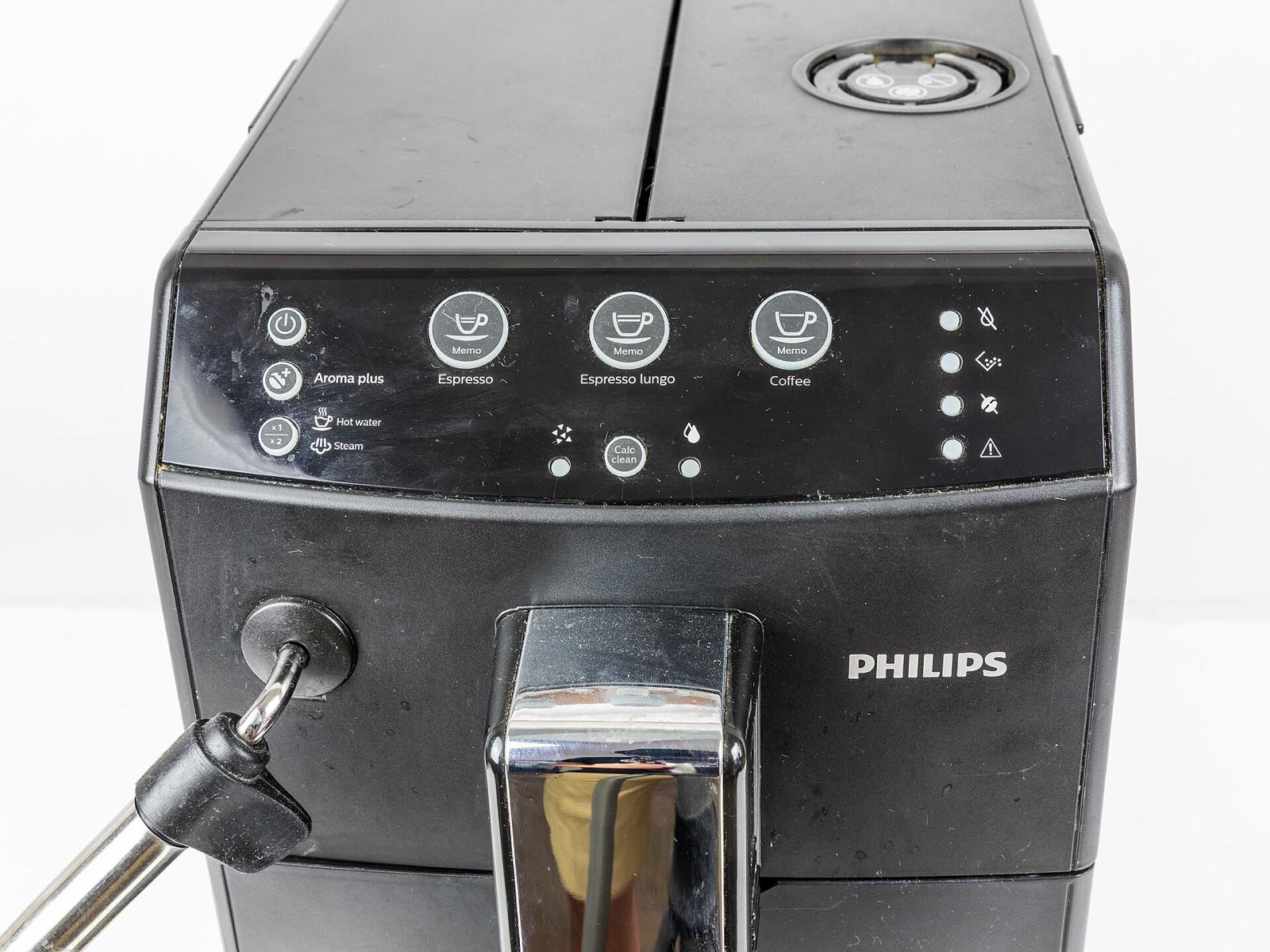
Portable machines: a hand pump and a kettle
Portable espresso makers are small, hand-powered presses for travel. The Wacaco Minipresso GR in our catalogue weighs 0.79 lb by Wacaco's listing, uses pre-ground coffee and boiling water, and is pumped 'a few strokes to pressurize and extract espresso'. It makes up to 50 ml.
Wacaco's listing does not state a pressure figure, so the type cannot be checked against the 9 bar that INEI gives for espresso. Treat a portable as a travel tool: it trades temperature stability and repeatability for something that fits in a bag.
The second axis: thermoblock, single boiler, heat exchanger, dual boiler
Any pump machine, semi or super, needs hot water for the shot and, for milk, much hotter steam. How it makes both is the heating system, and it matters more than the 'type' label for anyone who drinks lattes. The definitions below are the makers' own: Quick Mill on thermoblocks and single boilers, Profitec and La Marzocco USA on heat exchangers and dual boilers, and Breville for its ThermoJet and Thermocoil names.
Our catalogue contains no heat-exchanger machine, so the count chart in the first section shows none; the type is included here because Profitec and La Marzocco USA both define it alongside the dual boiler.
| Heating system | How it works | Brew and steam at once? | Catalogue count | Example |
|---|---|---|---|---|
| Thermoblock (incl. Breville ThermoJet, Thermocoil) | Heats water on demand as it flows through; Quick Mill says this allows 'very fast heat-up times' | Depends on the model | 21 | Breville Bambino, Jura E8 |
| Single boiler | One boiler for brewing and steaming; Quick Mill: 'Requires waiting when switching' | No | 7 | Gaggia Classic E24, Rancilio Silvia |
| Heat exchanger | One boiler at steam temperature; a tube flash-heats brew water; La Marzocco says it 'requires a cooling flush' | Yes | 0 | None in our catalogue |
| Dual boiler | Two independent boilers, one for brew, one for steam | Yes | 5 | Breville Dual Boiler, Lelit Bianca |
| None (you add hot water) | Kettle water poured in by hand | No milk | 3 | Flair Classic, Wacaco Minipresso GR |
How long each type takes to heat up
Heat-up time follows the heating axis more than the type label, but only a minority of makers publish one. In our 45-machine catalogue, 10 machines carry a maker's heat-up claim and 9 of those give a number. Flow-through heaters own the fast end: Breville says the Bambino and Bambino Plus are "ready to start in 3 seconds", gives a "3 second heat up time" for the Barista Pro and Barista Touch, and says the Barista Touch Impress reaches "optimum extraction temperature in 3 seconds". CASABREWS lists 5 seconds for the 5418 Pro, and Philips says its 5500 Series LatteGo super-automatic is "Ready-to-brew in 3 seconds with QuickStart", without naming the heater.
Boiler machines are a different story, mostly because their makers say nothing. Of the 12 single- and dual-boiler machines in the catalogue, two publish a figure: Fellow says the Espresso Series 1, which combines a flow-through heater, a boiler and a grouphead heater in what it calls a "Boosted Boiler", is "Ready to brew in two minutes or less", and Profitec gives "approx. 7 min" for the GO in its Fast Heat-Up Mode. None of the five dual-boiler machines (Breville, Meraki, Profitec, Lelit, Rancilio) publishes a heat-up time, and neither does Breville for the Barista Express, the Barista Express Impress or the Oracle Jet, which promises only "optimum extraction temperature in seconds". Lever presses and portables have no heater at all; their wait is your kettle.
So a missing number is not a slow machine, just an unstated one, and a figure you see for a boiler machine on a retailer's page is not the maker's. Read heat-up claims for what they promise, too: "ready to start" and "optimum extraction temperature" are not the same wording, and none of these claims covers warming a cold portafilter or cup, or the second wait a single boiler needs to switch from brewing to steaming temperature.
| Machine | Type | Heater (maker's term) | Maker's claim | As time |
|---|---|---|---|---|
| Breville Bambino | Semi-automatic | ThermoJet | "ready to start in 3 seconds" | 3 s |
| Breville Bambino Plus | Semi-automatic | ThermoJet | "ready to start in 3 seconds" | 3 s |
| Breville Barista Pro | Semi-automatic with grinder | ThermoJet | "3 second heat up time" | 3 s |
| Breville Barista Touch | Semi-automatic with grinder | ThermoJet | "3 second heat up time" | 3 s |
| Breville Barista Touch Impress | Semi-automatic with grinder | ThermoJet | "optimum extraction temperature in 3 seconds" | 3 s |
| Philips 5500 Series LatteGo | Super-automatic | Not published | "Ready-to-brew in 3 seconds with QuickStart" | 3 s |
| CASABREWS 5418 PRO | Semi-automatic | Flashheat Technology (Thermoblock Heating System) | "5 seconds" | 5 s |
| Fellow Espresso Series 1 | Semi-automatic | Boosted Boiler | "Ready to brew in two minutes or less" | 2 min |
| Profitec GO | Semi-automatic | Single boiler | "Fast Heat-Up Mode: Heating phase approx. 7 min" | 7 min |
| Breville Oracle Jet | Semi-automatic with grinder | ThermoJet | "fast heat up achieves the optimum extraction temperature in seconds" | No number |
Not an espresso machine: moka pots, and the 15-bar myth
A moka pot is often sold as a 'stovetop espresso maker', but by pressure it is a different brewer. Bialetti, which makes the Moka Express, says the moka 'uses a pressure of about 1.5 bars', against 'at least 9 bars' for modern espresso machines. INEI's guide sets espresso at 9 bar plus or minus 1, and the heritage SCAA definition at 9 to 10 atmospheres, so moka coffee does not meet either. It is strong and good, and it is stovetop coffee.
The opposite mistake is reading a big pump number as quality. Pump ratings of 15, 19 or 20 bar are maximums. Breville's own Barista Express manual calls its pump 'the 15 bar Italian pump', and its Dual Boiler manual treats a gauge 'not reaching 9 bars' as the fault to fix. Choose a type by what it asks of you, never by the bar figure on the box.
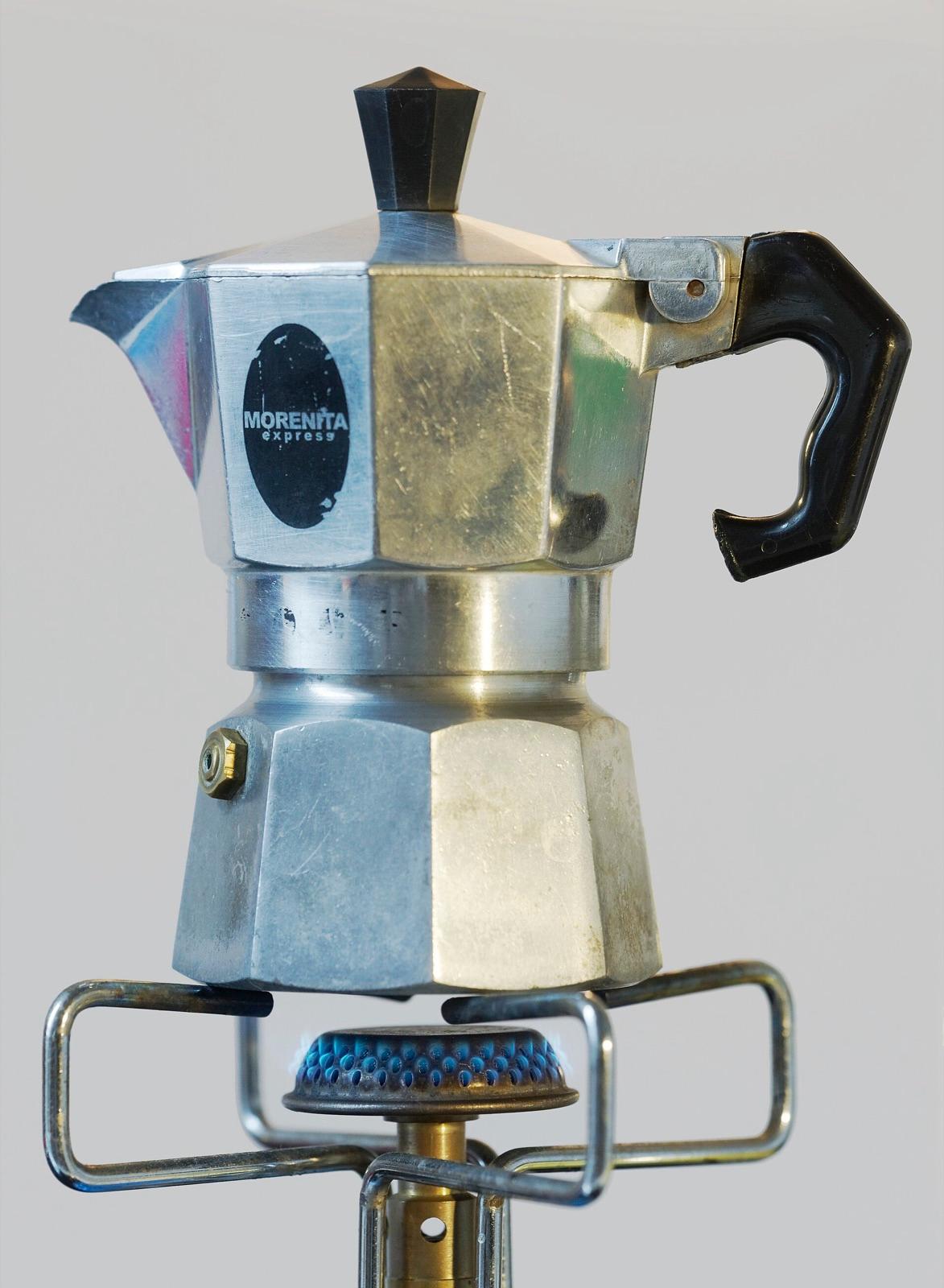
Pick a type in four questions
Work down the list and stop at the first answer that fits. Then use the finder tool to narrow the catalogue by budget, drinks, effort, grinder and counter width.
- Do you want to press one button and walk away? Choose a super-automatic. Expect to start around $550 by makers' list prices.
- Do you mostly drink milk drinks, several in a row? Look at the heating axis first: a dual boiler avoids the single-boiler wait.
- Do you want one box but still want to tamp and time shots yourself? A semi-automatic with a built-in grinder, or an assisted model if tamping and dosing put you off.
- Do you want the most control for the money, and will you buy a grinder? A plain semi-automatic, or a manual lever press if you only drink straight espresso and want to spend least.
Every page in this section
- Espresso Machines for Lattes
Best espresso machine for lattes by milk system: manual wand, automatic wand, carafe or whisk, plus boiler type for back-to-back drinks. Maker specs only.
- Dual Boiler Espresso Machines
Dual boiler espresso machine guide: how two boilers differ from single boiler, heat exchanger and thermoblock heating, with boiler sizes and 4 machines.
- Espresso Machine Comparison
Espresso machine comparison tool and chart: filter 45 machines by type, heater, PID, grinder, portafilter and milk, and learn what each spec column means.
- Espresso Machines With a Grinder
Espresso machine with grinder or separate grinder? Compare cost, counter width, grind settings and repair risk, with built-in models from $300 to $2,000.
- Manual Espresso Machines
Manual espresso machine guide: what a lever press like the Flair does, what you give up (steam, heat, speed), the grinder it needs, and three models compared.
- Super-Automatic Espresso Machines
Super automatic espresso machine picks from De'Longhi, Philips, Jura and Ninja, compared by milk system, grind steps, cleaning claims and counter depth.
Questions people ask
- What are the main types of espresso machines?
- By who does the work: manual lever, semi-automatic, semi-automatic with a built-in grinder (some with assisted tamping), super-automatic and portable. By heating: thermoblock, single boiler, heat exchanger and dual boiler.
- What is the difference between automatic and super-automatic?
- Usage varies. On this site, automatic or assisted machines still use a portafilter you lock in, with help on grinding, dosing or tamping. A super-automatic has no portafilter for you: it grinds, tamps and brews internally from one button.
- Which type of espresso machine is best for beginners?
- It depends on the goal. For drinks without learning, a super-automatic. For learning espresso, a semi-automatic with single and dual wall baskets and a separate grinder, or one with a built-in grinder to keep it to one purchase.
- Is a Nespresso or capsule machine an espresso machine?
- Capsule machines are outside this catalogue, which covers machines that use ground coffee or whole beans. Check any machine's own spec page for how it brews before comparing it with the types here.
- Do I need a dual boiler?
- Only if you often steam milk and pull shots back to back. A single boiler makes you wait while it switches temperature; a dual boiler keeps brew and steam at their own temperatures at the same time.
- Which type of espresso machine heats up fastest?
- By makers' published claims, flow-through machines: Breville's ThermoJet models and the Philips 5500 claim 3 seconds and the CASABREWS 5418 Pro 5 seconds. Fellow says two minutes or less for the Series 1 and Profitec about 7 minutes for the GO. Most boiler machines publish no figure.
Sources & further reading
- Quick Mill, Guide to choosing an espresso machine: thermoblock, single boiler, PID (2026-11-09)
- Profitec, Which Profitec espresso machine suits you: heat exchanger, dual boiler (2026-11-09)
- La Marzocco USA, The importance of dual boilers (2026-11-09)
- Breville Bambino BES450 US product page: ThermoJet (2026-11-09)
- Breville Barista Express BES875 instruction book: Thermocoil, baskets, 15 bar pump (2026-11-09)
- Breville Dual Boiler BES920 instruction book: 9 bar, OPV (2026-11-09)
- Breville Oracle Jet BES985 US product page (2026-11-09)
- Flair Classic product page (2026-11-09)
- Flair 49 PRO product page (2026-11-09)
- Wacaco Minipresso GR listing on Amazon (2026-11-09)
- INEI, A Brief Guide to the Italian Certified Espresso, archive copy (2026-11-09)
- SCA 25 Magazine, Defining the Ever-Changing Espresso (2026-11-09)
- Bialetti, How the Moka works (2026-11-09)
- Encyclopaedia Britannica, espresso, archive copy (2026-11-09)
- Ninja Luxe Café Pro listing on Amazon (2026-11-09)
- De'Longhi La Specialista Opera US product page (2026-11-09)
- De'Longhi Magnifica Evo US product page (2026-11-09)
- Philips 2200 Series US product page (2026-11-09)
- JURA E8 US product page (2026-11-09)
- Breville Barista Pro product page (2026-11-09)
- Breville Barista Touch product page (2026-11-09)
- Breville Barista Touch Impress product page (2026-11-09)
- Philips Series 5500 LatteGo, Philips listing on Amazon (2026-11-09)
- CASABREWS 5418 Pro product page (2026-11-09)
- CASABREWS 5418 Pro, CASABREWS listing on Amazon (steam switching claim, 2026-11-09)
- Fellow Espresso Series 1 product page (2026-11-09)
- Profitec GO product page (archive copy, read 2026-11-09)
Read next
- Super-Automatic Espresso Machines
Super automatic espresso machine picks from De'Longhi, Philips, Jura and Ninja, compared by milk system, grind steps, cleaning claims and counter depth.
- Dual Boiler Espresso Machines
Dual boiler espresso machine guide: how two boilers differ from single boiler, heat exchanger and thermoblock heating, with boiler sizes and 4 machines.
- Manual Espresso Machines
Manual espresso machine guide: what a lever press like the Flair does, what you give up (steam, heat, speed), the grinder it needs, and three models compared.
- Espresso Machines With a Grinder
Espresso machine with grinder or separate grinder? Compare cost, counter width, grind settings and repair risk, with built-in models from $300 to $2,000.
- PID Espresso Machines
PID espresso machine explained: what the controller does, when it matters by boiler type, and 28 machines showing which makers state PID and which do not.
Back to the EspressoGoods home page.
EspressoGoods editors · Editorial team
EspressoGoods' catalogue and guides are compiled by the site's editorial team from espresso machine and grinder makers' own product pages, spec sheets and manuals, plus standards bodies such as the Istituto Nazionale Espresso Italiano. We do not test machines or taste shots, and we never claim to: every spec on the site links to the page it came from.
About this site · How pages are checked · Last updated November 9, 2026
As an Amazon Associate, EspressoGoods earns from qualifying purchases. It costs you nothing extra and never decides which machines we list.
EspressoGoods is an independent site. It is not affiliated with Breville, De'Longhi, Gaggia, Rancilio, Philips, Ninja or any other maker. Brand names and trademarks belong to their owners. Specs are the makers' published figures; check the maker's page before you buy.