Guide
Espresso Tamper Size Guide: Measure the Basket, Then Choose the Type
By EspressoGoods editors · Updated 2026-11-08 · How we research
Short answer
Match the tamper to your basket's inside diameter: 51 mm for the CASABREWS CM5418, 54 mm for Breville Bambino and Barista models, 58 mm for the Gaggia Classic. Size not published? Measure the rim.
Before you buy an espresso tamper, take the filter basket out of your portafilter and measure it. Lay a ruler, or better a pair of calipers, across the top of the basket from inside edge to inside edge, and read the figure in millimetres. That number, not the machine's brand or its marketing name, decides which tamper fits.
Machine makers usually describe the size as the portafilter size: Breville's Bambino is a '54mm portafilter', Gaggia's Classic E24 has a '58 mm filter-holder'. Tampers are sold by the same millimetre figure. The catch is that many makers never print a size at all. Of the 45 home machines in our catalogue, built from makers' spec pages on 9 November 2026, 25 publish no portafilter diameter. For those, the tape measure is the only spec sheet you have.
Measure your basket in four steps
A tamper has to slide into the basket and press the coffee flat right to the edge. Too large and it will not go in; too small and it leaves a ring of loose coffee around the outside. Measuring takes a minute.
No calipers? A plain metric ruler laid across the rim works if you sight straight down on it, and repeating the reading at right angles catches an oval reading from a ruler that slipped. If two readings differ by more than a millimetre, measure again. The goal is the inside edge at the very top, where the tamper enters, not the narrower bottom of the basket.
If your machine came with a tamper, measure that too. A maker's own tamper tells you the size the maker designed around, though it may be a simple plastic one. And if you own baskets from more than one source, measure each, because a tamper that fits one snugly may not fit the other.
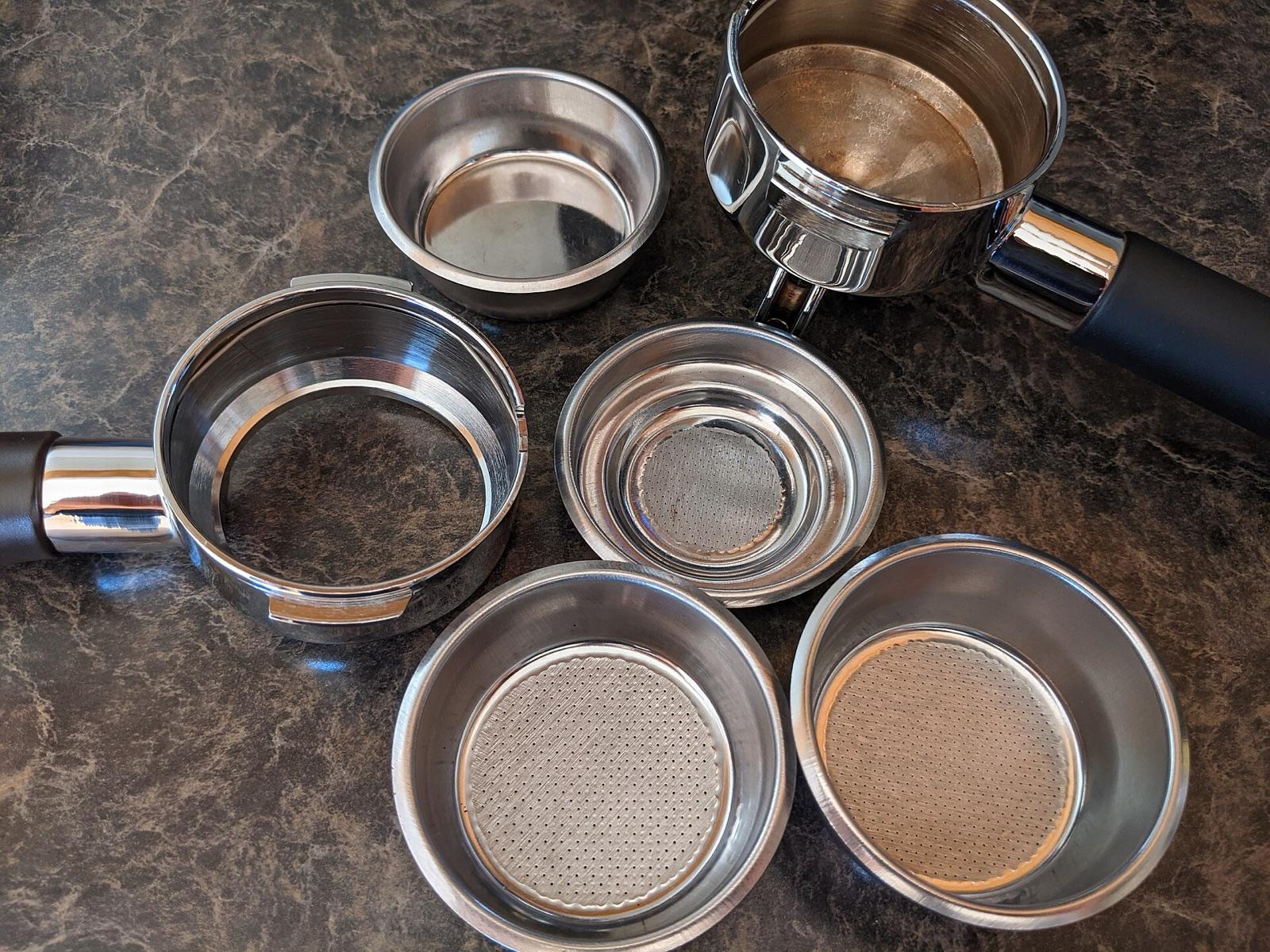
- Remove the basket from the portafilter, or measure it in place if it does not come out easily. Use the basket you will actually brew with: single and double baskets from the same maker can differ in depth.
- Measure the inside diameter across the very top, from inner edge to inner edge, through the centre. Calipers give a reading to a tenth of a millimetre; a ruler gets you to the nearest millimetre.
- Compare with the maker's figure, if there is one. If the maker publishes 54 mm and you measure close to that, buy a tamper sold for 54 mm machines.
- Check the tamper's stated base diameter before ordering. It must be smaller than your measured inside diameter to enter the basket; the closer it is, the less untamped coffee is left at the edge.
Portafilter sizes, machine by machine
This is every machine in our catalogue grouped by the portafilter size its maker publishes. If your machine is in the last row, its maker gives no figure on the spec pages we read, so measure the basket.
Two patterns stand out. Breville's whole Bambino and Barista line uses 54 mm, while its Dual Boiler and Oracle Jet step up to 58 mm. And 58 mm is the size shared across the most brands here: Breville, Gaggia, Fellow, Lelit, CASABREWS and Meraki.
The 'not published' row is long for a reason. Super-automatics have no portafilter you can reach, so they have no size to publish. The others, including every De'Longhi semi-automatic in the catalogue and all three Rancilio Silvia models, sell portafilters you tamp by hand but leave the diameter off the pages we read. If your machine is one of these, the four steps above are the reliable route.
| Published size | Machines | Count |
|---|---|---|
| 40 mm | Flair Classic (manual lever) | 1 |
| 49 mm | Flair 49 PRO (manual lever) | 1 |
| 51 mm | CASABREWS CM5418, CASABREWS 3700 Essential | 2 |
| 54 mm | Breville Bambino, Bambino Plus, Barista Express, Barista Express Impress, Barista Pro, Barista Touch, Barista Touch Impress | 7 |
| 58 mm | Breville Dual Boiler, Breville Oracle Jet, Gaggia Classic E24, Gaggia Classic Evo Pro, Fellow Espresso Series 1, Lelit Bianca, CASABREWS Ultra, CASABREWS Marenza, Meraki dual boiler | 9 |
| Not published | De'Longhi Stilosa, Classic, La Specialista Touch and Opera; Rancilio Silvia, Silvia with PID, Silvia Pro X; Profitec GO and Pro 600; CASABREWS 5418 PRO; Chefman CraftBrew; Ninja Luxe Café Premier, Pro and Mini; Wacaco Minipresso GR; and all 10 super-automatics (which have no portafilter to tamp) | 25 |
What tamping changes, in the makers' words
Tamping presses the ground coffee into an even, level bed so that water meets the same resistance across the whole basket. Machine makers treat it as one of the three things you control, alongside grind and dose.
Breville's instruction books say single wall baskets 'allow you to experiment with grind, dose and tamp', and that dual wall baskets 'regulate the pressure and help to optimise the extraction regardless of the grind, dose, tamp pressure or freshness'. So how much your tamp matters depends on the basket. With a pressurised basket, a cheap tamper is fine. With a single wall basket, a well-fitting tamper and a level tamp matter more.
Breville's Dual Boiler manual makes the link to pressure explicit. Under 'Pressure gauge not reaching 9 bars' it lists 'Coffee not tamped firmly enough' as a cause. Nine bar is the extraction pressure the Istituto Nazionale Espresso Italiano gives for espresso, plus or minus 1.
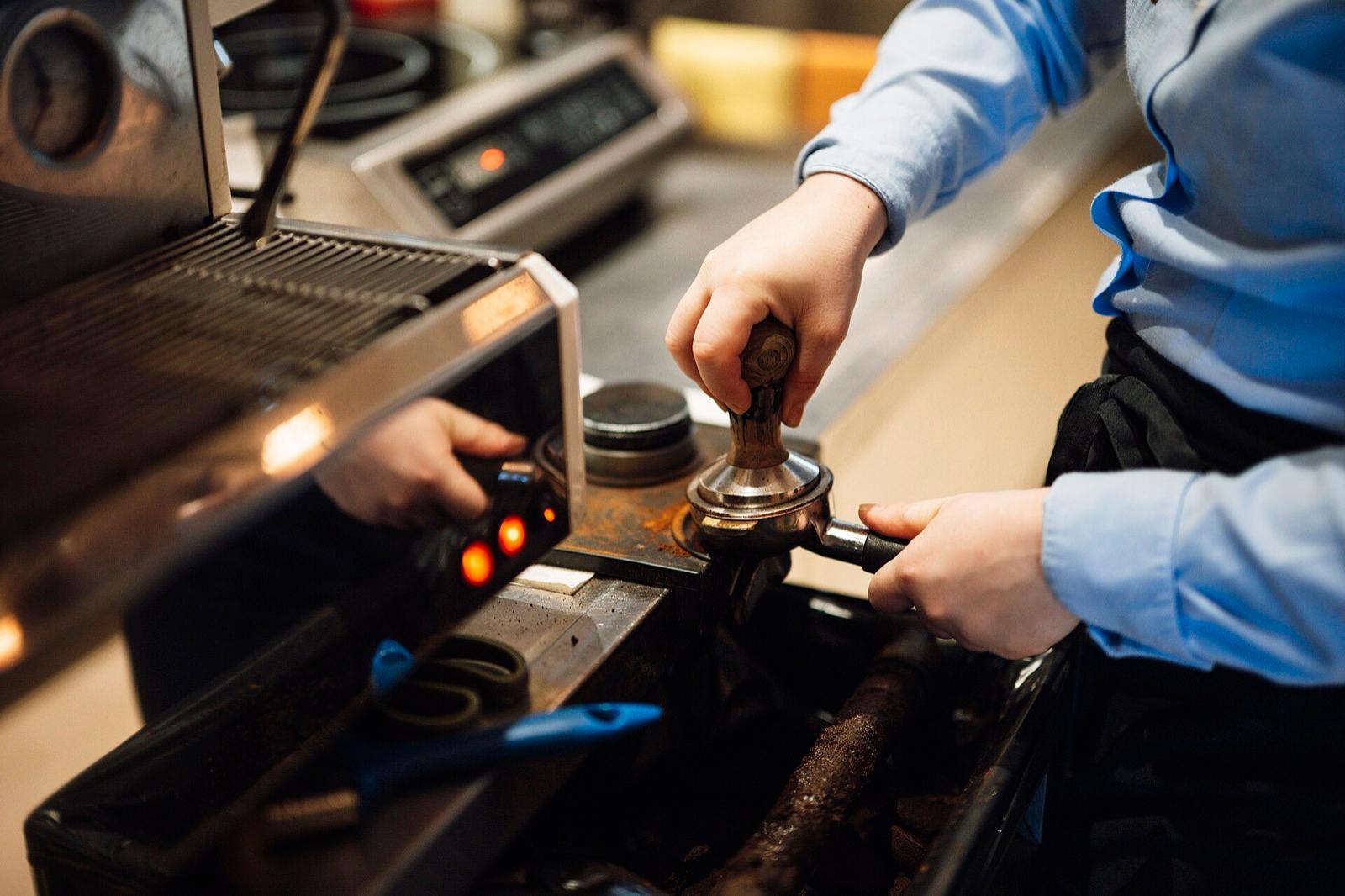
A level tamp matters as much as a firm one. If the tamper goes in at an angle, one side of the coffee bed ends up denser than the other, and water takes the easier path. That is the practical reason a tamper close to the basket's diameter helps: there is less room for it to tilt. A tamper well under size can rock, and leaves a ring of loose coffee at the wall.
How hard should you press? Makers don't agree
You will see one tamping force quoted as a rule online. No source on our register publishes one, and the machines that tamp for you show why: their makers chose very different numbers.
Breville says the Barista Touch Impress uses 'assisted 22lb tamping'. De'Longhi says the La Specialista Opera's Smart Tamping Technology presses 'with 20 kg of even pressure', which is about 44 lb (20 kg x 2.2046). Breville's Barista Express Impress adds a '7° Barista Twist finish', which describes a motion, not a force. Two serious makers, a factor of two apart.
The practical reading is that consistency matters more than any one figure. Press firmly until the coffee stops compressing, keep the tamper level, and do it the same way every time; then change the grind, not the tamp, to adjust the shot. Baratza's dialling-in advice works that way: grind finer if the shot is sour and quick, coarser if bitter and slow.
Flat, convex, spring-loaded or plastic?
Once the size is right, the choice is about how the tamper helps you repeat the same tamp. Tamper shops sell bases that are flat or convex (slightly domed), and some sell spring-loaded or calibrated tampers whose handle gives way at a set force, so every press stops at the same point.
A flat base leaves a level, flat puck surface. A convex base leaves a slightly dished one. A spring-loaded design takes force out of the equation, which suits anyone who finds 'press firmly' too vague. None of the machine makers on our register says one shape extracts better, so treat base shape as preference, and size as the requirement.
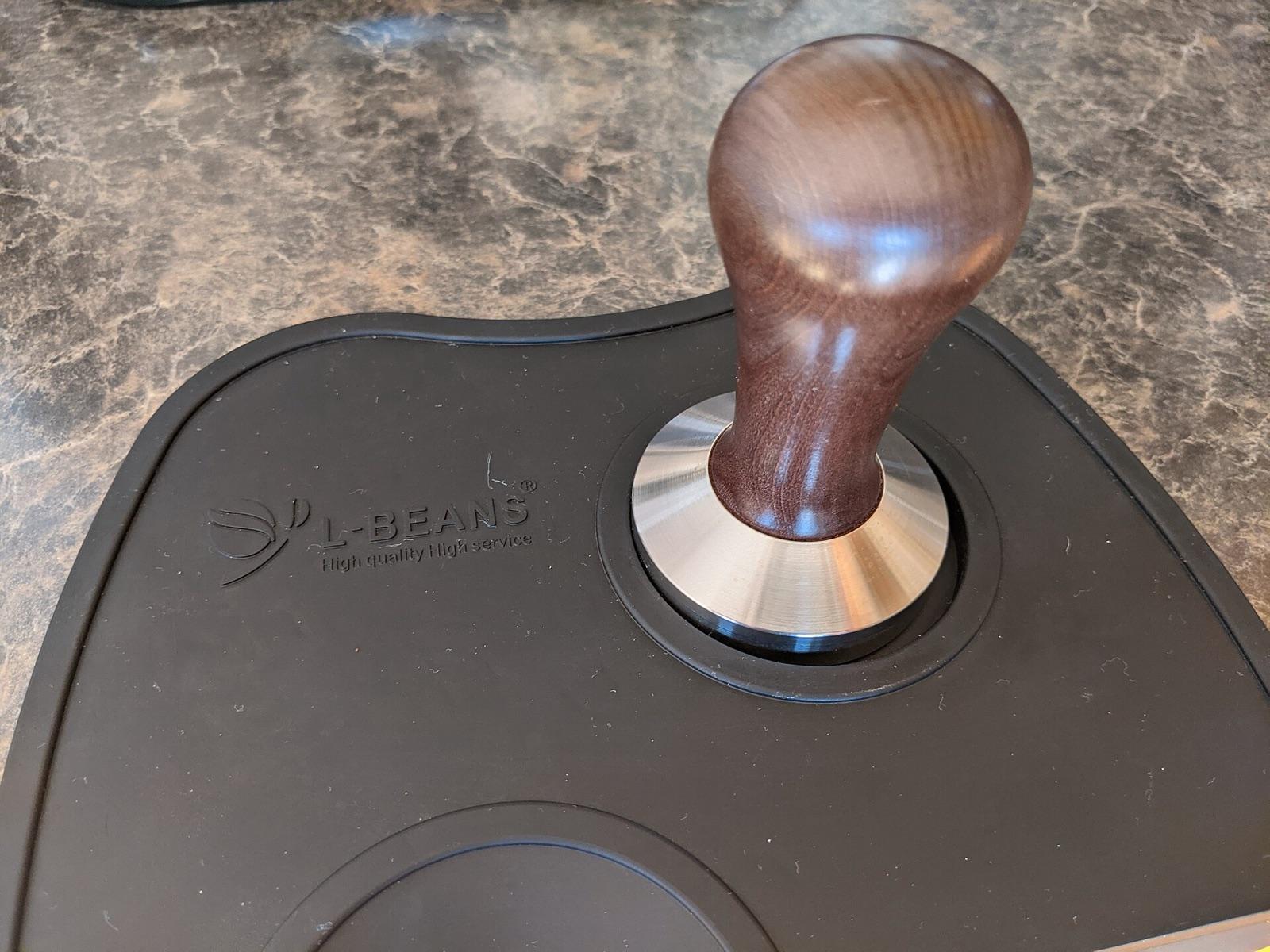
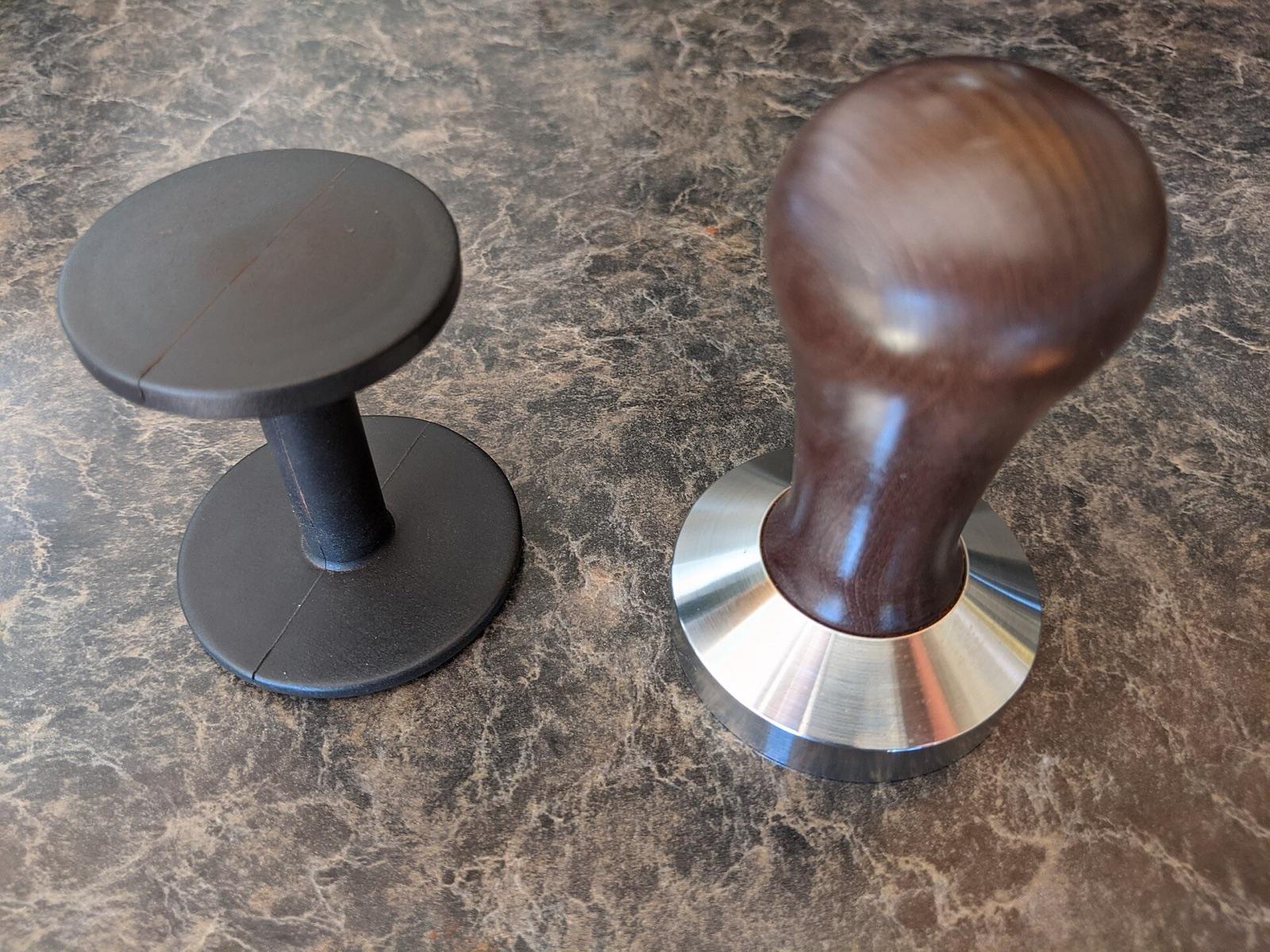
Material is the last choice. A light plastic double-ended tamper, like the one in the photo below, does the job with pressurised baskets, but if its base is well under the basket's diameter it leaves a ring of loose coffee at the edge. A stainless steel tamper made for your exact size closes that gap, and a rubber tamping mat, like the one in the photo at the top, protects the counter and the portafilter spouts.
Handle shape is personal too. A taller handle gives more leverage and keeps your knuckles off the rim; a flatter one sits lower in the palm. Since none of this changes the size you need, settle the millimetres first and choose the handle second.
Machines that tamp for you
Some machines remove the tamper from the routine, fully or partly. If you own one, a separate tamper may be unnecessary, or useful only as a backup.
Breville's Oracle Jet will 'auto grind, dose & tamp into a 58 mm portafilter'. The Barista Express Impress and Barista Touch Impress use the Impress Puck System with assisted tamping. Ninja lists an 'integrated tamper at the pull of a lever' on the Luxe Café Pro and 'assisted tamping' on the Luxe Café Premier. De'Longhi's La Specialista Opera has its lever-operated Smart Tamping Technology. Super-automatics tamp inside the brew unit, so there is nothing to measure.
Manual lever presses go the other way. The Flair Classic takes a 40 mm portafilter and the Flair 49 PRO a 49 mm basket, both sizes outside the 51 to 58 mm range that most pump machines in our catalogue use, so check that a tamper is sold specifically for that size. For the rest of the espresso routine, from grind to milk, see our how to make espresso guide.
If you want a hand tamper as a backup on an assisted machine, or to use with a different basket, measure as for any machine: Breville gives 58 mm for the Oracle Jet and 54 mm for the Impress models, while Ninja and De'Longhi give no portafilter size for their assisted machines.
Questions people ask
- What size espresso tamper do I need?
- One sized for your basket's inside diameter. Measure across the top rim in millimetres, then match the maker's published portafilter size if there is one: 51, 54 and 58 mm are the common pump-machine sizes in our catalogue.
- What size tamper fits a Breville Bambino or Barista Express?
- Breville lists a 54 mm portafilter for the Bambino, Bambino Plus and every Barista Express, Pro and Touch model. The Breville Dual Boiler and Oracle Jet use 58 mm.
- Does the type of tamper matter?
- Size matters most. Base shape (flat or convex) is preference. A spring-loaded or calibrated tamper helps you press with the same force each time, which matters more with single wall baskets than with pressurised ones.
- How hard should I tamp espresso?
- Firmly and the same way every time. Makers disagree on a figure: Breville's assisted tamping is 22 lb, De'Longhi's is 20 kg (about 44 lb). Adjust the grind to change the shot, not the tamp.
Sources & further reading
- Breville Bambino BES450 US product page: 54mm portafilter (2026-11-09)
- Breville Bambino BES450 US instruction book: basket capacities (2026-11-09)
- Breville Barista Express BES875 instruction book: single and dual wall baskets (2026-11-09)
- Breville Dual Boiler BES920 instruction book: 'not reaching 9 bars' (2026-11-09)
- Breville Oracle Jet BES985 US product page (2026-11-09)
- Breville Barista Touch Impress US product page (2026-11-09)
- Breville Barista Express Impress BES876 US product page (2026-11-09)
- Gaggia Classic E24 product page, Tech Info (2026-11-09)
- De'Longhi La Specialista Opera US product page (2026-11-09)
- Rancilio Home Line catalogue 2022: Silvia Pro X kit (2026-11-09)
- Ninja Luxe Café Pro listing on Amazon (2026-11-09)
- Ninja Luxe Café Premier listing on Amazon (2026-11-09)
- Flair Classic product page (2026-11-09)
- Flair 49 PRO product page (2026-11-09)
- CASABREWS CM5418 US product page (2026-11-09)
- INEI, A Brief Guide to the Italian Certified Espresso, archive copy (2026-11-09)
- Baratza, Dialing in Espresso (2026-11-09)
Read next
- How to Make Espresso
How to make espresso at home, step by step: INEI and SCAA parameters, an 18 g in, 36 g out recipe, grind, tamp and timing, and fixes when a shot tastes off.
- Breville Espresso Machines
Breville espresso machines compared rung by rung, Bambino to Oracle Jet: heater, PID, grinder settings, milk system and height from Breville's own spec pages.
- De'Longhi Stilosa
DeLonghi Stilosa specs from De'Longhi's own page: single boiler, 15 bar pump, manual wand, no PID or size listed. What it can't do, and the rivals to weigh.
- Gaggia Classic Pro vs Bambino
Gaggia Classic Pro vs Bambino: a single brass boiler and 58 mm portafilter against a 3-second ThermoJet with PID and 54 mm baskets. Specs, workflow, verdict.
- Espresso Grinders
Espresso grinder guide: 14 grinders sorted by what their makers say about espresso, with burr size, settings, stepless or stepped, and a machine matcher.
Part of How to Make Espresso. Back to the EspressoGoods home page.

EspressoGoods editors · Editorial team
EspressoGoods' catalogue and guides are compiled by the site's editorial team from espresso machine and grinder makers' own product pages, spec sheets and manuals, plus standards bodies such as the Istituto Nazionale Espresso Italiano. We do not test machines or taste shots, and we never claim to: every spec on the site links to the page it came from.
About this site · How pages are checked · Last updated November 8, 2026
As an Amazon Associate, EspressoGoods earns from qualifying purchases. It costs you nothing extra and never decides which machines we list.
EspressoGoods is an independent site. It is not affiliated with Breville, De'Longhi, Gaggia, Rancilio, Philips, Ninja or any other maker. Brand names and trademarks belong to their owners. Specs are the makers' published figures; check the maker's page before you buy.