Section
How to Make Espresso at Home: The Recipe, the Ratio and the Fixes
By EspressoGoods editors · Updated 2026-11-08 · How we research
We may earn a commission when you buy through links on this page.
Short answer
Grind 18 g of coffee fine, tamp it level in the basket and brew about 36 g of espresso in 25–32 seconds at around 9 bar. That is Baratza's simple recipe. The Italian standard (INEI) is smaller: 7 g of coffee, 25 ml in the cup, 25 seconds, water at 88 °C. If the shot is sour and fast, grind finer; if bitter and slow, grind coarser. Breville pairs single-wall baskets with fresh grounds and dual-wall baskets with pre-ground coffee.
How to make espresso, in seven steps: (1) heat the machine; (2) weigh 18 g of coffee; (3) grind it fine; (4) level and tamp it in the basket; (5) lock in and brew at about 9 bar; (6) stop at about 36 g of liquid after 25–32 seconds; (7) taste, then grind finer if it was sour and fast or coarser if it was bitter and slow. That is Baratza's simple recipe, and every number in it comes from a maker or a standards body rather than from us.
The rest of this page explains each step, shows how the home recipe compares with the Italian standard and the heritage SCAA definition, and covers what goes wrong: pre-ground coffee in the wrong basket, a grinder that can't go fine enough, and the pump-pressure myth. The guides listed below this hub go deeper on single questions such as tampers, PID and warm-up times.
Kit that covers the recipe
1. Starter machine
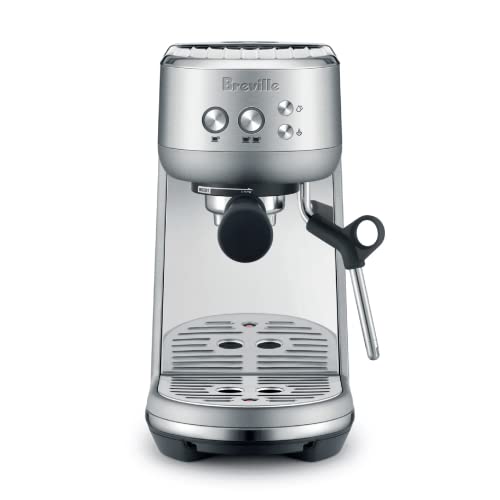
Breville Bambino
Breville lists a low-pressure pre-infusion followed by 9 bar extraction, PID temperature control and a ThermoJet heater it says is ready in 3 seconds. Its 54 mm basket takes 18 g by Breville's figure, which matches the home recipe on this page.
Buy it if: Learning the recipe without a long warm-up. Skip it if: You want milk textured for you; see the Bambino Plus.
- Type
- Semi-automatic
- Heating
- ThermoJet
- PID
- Yes
- Portafilter
- 54 mm
- Milk
- steam wand (manual milk texturing)
- Heat-up (maker)
- ready to start in 3 seconds
- Water tank
- 47 fl.oz
- Size (W×D×H)
- 7.7 x 12.6 x 12.2 in (W x D x H, Breville listing on Amazon)
- Weight
- 10.42 lb
Specs: Breville US product page (2026-11-09); Breville listing on Amazon (2026-11-09)
2. Grinder for the recipe
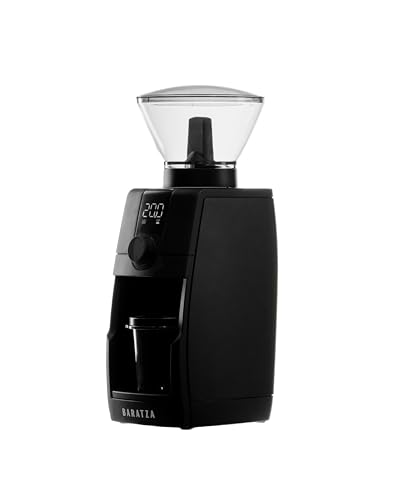
Baratza Encore ESP
Baratza sells the Encore ESP for espresso, with micro-steps 1–20 for the espresso range and macro-steps 21–40 for filter. Fine steps in the espresso zone are what let you follow the grind-finer, grind-coarser fixes below.
Buy it if: A first espresso grinder. Skip it if: You want stepless adjustment.
- Burrs
- 40mm Conical Steel (M2)
- Espresso
- Maker sells it for espresso
- Settings
- 40
- Hopper
- 300g (10.6oz)
- Size (W×D×H)
- 13 x 15 x 34 cm (W x D x H)
- Weight
- 5.56 lb
Specs: Baratza US product page (2026-11-09); Baratza listing on Amazon (2026-11-09)
3. No-electricity option
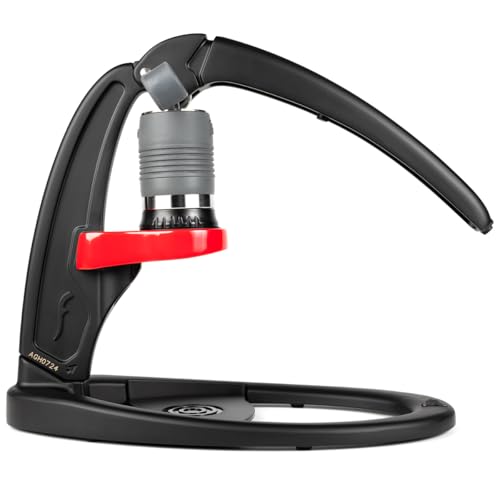
Flair Classic
Flair's lever press lists 9 bar brewing with a pressure gauge, a 12–18 g dose and a yield up to 45 ml, using water from a kettle. It can follow the same recipe, one shot per fill, without steam.
Buy it if: Straight espresso, travel, or no spare outlet. Skip it if: You make milk drinks.
- Type
- Manual lever
- Heating
- No heater (manual)
- Portafilter
- 40 mm
- Milk
- none
- Water tank
- Input Water Capacity – 60ml
- Size (W×D×H)
- 12.5" L x 6.25" W x 10" H (assembled)
- Weight
- 5 lb
Specs: Flair Espresso US product page (2026-11-09); Flair listing on Amazon (2026-11-09)

Product prices and availability are accurate as of 2026-11-13 and are subject to change. Amazon prices are for the colour linked. Specs are the makers' published figures; we don't test machines.
Which grinder goes with your machine?
Espresso needs a fine, finely adjustable grind. This lists grinders their makers market for espresso, and separates the ones sold for drip or pour-over.
Sold for espresso by their makers (11), most finely adjustable first (stepless, then most settings)
HiBREW G5
48mm Conical Burr (CNC machined 5-core stainless steel) · stepless · single-dose
Maker: “HiBREW: "All-around single dose grinder perfect for espresso and filtered coffee"; "Infinite grind settings allow ultra micro fine-tuning, perfect for dialing in espresso".”
Fellow Opus 2
48 mm stainless steel conical · stepless
Maker: “Fellow: "Perfect for espresso, Opus 2 is a precision electric coffee grinder for every method"; "Usage: Designed for espresso, pour-over, electric coffee makers, French press, AeroPress®, and cold brew."”
MiiCoffee DF54
Custom made 54mm stainless steel flat burrs · stepless · single-dose
Maker: “MiiCoffee listing: "The adjustment is stepless. It can be dialed in for espresso with high precision."”
Baratza Encore ESP Pro
40mm Conical Burrs (M2) · stepless · single-dose
Maker: “Baratza: stepless adjustment "from fine-tuned espresso to breezy pour-over and everything in between"; Amazon title: "from espresso fine to cold brew coarse"; Amazon feature: "fluffy, ready-to-tamp espresso grounds".”
MiiCoffee DF64 II
Custom made 64mm stainless steel flat burrs · stepless · single-dose
Maker: “MiiCoffee listing: "The adjustment is stepless. It can be dialed in for espresso with high precision."”
KitchenAid Burr Coffee Grinder
Commercial-grade, stainless steel conical burrs · 70 settings
Maker: “KitchenAid listing: "70 precise settings for a wide variety of grind sizes - from coarse for Cold Brew and French Press, to fine for Espresso and espresso drinks."”
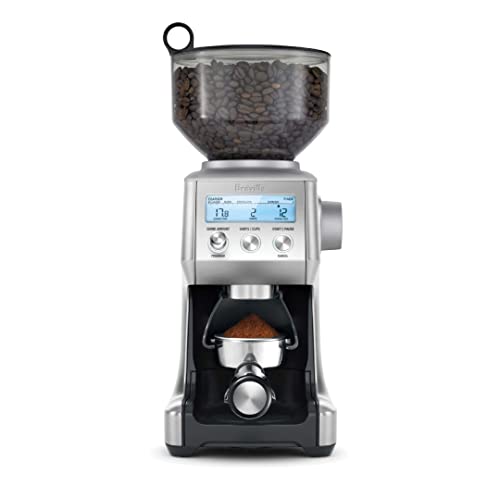
Breville Smart Grinder Pro
Stainless Steel Conical Burrs · 60 settings
Maker: “Breville: "Choose between 'cups' for French Press or Filter and 'shots' for Espresso"; "60 Precise Grind Settings from the finest espresso to the coarsest French Press grind."”
SHARDOR Conical Burr Espresso Coffee Grinder with Precision Timer 2.0
40 Millimeter Stainless Steel Conical Burr · 51 settings
Maker: “SHARDOR listing title: "Conical Burr Espresso Coffee Grinder"; feature: "51 Precise Grind Settings: Adjustable from the finest for Espresso to the coarsest for French Press Grind."”
Baratza Encore ESP
40mm Conical Steel (M2) · 40 settings
Maker: “Baratza: "Optimized for precision, the Encore ESP delivers the grind resolution you need to brew creamy, syrupy shots of espresso." Amazon listing: "micro-steps from #1-20 for high resolution espresso grinding, and macro-steps from #21-40 suitable for filter brewing methods."”
Baratza Virtuoso+
40mm Conical Steel (M2) · 40 settings
Maker: “Baratza's own page does not name a brew method; the Baratza Amazon listing: "40 grind settings give you access to an extensive range of brew methods, including espresso, French press and more".”
Cuisinart Supreme Grind Automatic Burr Mill
Stainless steel flat burrs · 18 settings
Maker: “Cuisinart listing title: "Grind settings for drip, espresso and French press"; feature: "18-position grind selector spans from ultra-fine for espresso to extra-coarse for a french press or cold brew."”






Sold for brewed coffee, not espresso
- OXO Brew Conical Burr Coffee Grinder ($98.98): maker says “OXO listing: "15 grind settings (plus 43 micro-adjustments): Easily customize your coffee grind—from fine for espresso to coarse for French press and cold brew." The listing title, though, names "Drip Coffee, French Press, Cold Brew".”
- Baratza Encore ($149.95): maker says “Baratza: "the top barista-recommended grinder to elevate your filter brew journey" (positioned for filter). Note: the Amazon listing lists espresso among brew methods: "explore the extensive range of brew methods (espresso, Aeropress, Hario V60, Chemex, French Press, and automatic brewers)".”
- Fellow Ode Brew Grinder Gen 2 ($399.95): maker says “Fellow: "Usage: Designed for brewed coffee methods only, including AeroPress®, pour over, electric coffee makers, French press, and cold brew. Ode is not intended for espresso."”
Specs are each maker's published figures (source linked per machine). Amazon prices as of 2026-11-13; prices change. We earn from qualifying purchases; it never affects matching or order, which is lowest price first.
Three published recipes, one table
There is no single official espresso recipe, but there are published reference points. INEI, the Italian espresso institute, sets conditions for its certified Italian espresso. The SCA reproduces the heritage SCAA definition in its 25 Magazine. Baratza, a grinder maker, publishes a simple starting recipe for home use. And the same SCA article surveyed working baristas about what they actually do.
Read the table across a row and the pattern is clear: everyone agrees on roughly 9 bar and 20–30 seconds; they differ on how much coffee goes in and how the output is measured. INEI's numbers describe a single shot by volume. Baratza and the survey describe a larger dose measured by weight.
| Parameter | INEI certified espresso | Heritage SCAA definition | Baratza simple recipe | SCA barista survey (average) |
|---|---|---|---|---|
| Coffee in | 7 g ± 0.5 | 7–9 g single; 14–18 g double | 18 g | 18–20 g |
| Liquid out | 25 ml ± 2.5 (including foam) | 25–35 ml single (x2 for double) | 36 g | 36.5 g |
| Time | 25 s ± 2.5 | 20–30 s | 25–32 s | 25–30 s |
| Water temperature | 88 °C ± 2 leaving the group | 90.5–96.1 °C | not stated | 200 °F |
| Pressure | 9 bar ± 1 | 9–10 atmospheres | not stated | 9 bar |
Dose, at a glance
The chart puts the coffee dose from each source on one scale, together with the capacity of a typical home basket. The single-shot figures sit at 7–9 g; the home recipe, the double range and the basket all sit around 18 g. If your machine came with 1 cup and 2 cup baskets, the 2 cup basket is the one the home recipe assumes.
What you need before you start
Espresso needs more kit than drip coffee, and skipping any one item tends to be the reason a first attempt fails.
- A machine that brews at about 9 bar. Any pump espresso machine is designed to; a lever press with a gauge lets you see it. A moka pot is not one (see the last section).
- A grinder sold for espresso. Breville's manual says the grind must be fine but not too fine, a range a grinder sold only for filter coffee may not reach.
- A scale that reads to at least a gram, because Baratza's recipe is written in grams in and grams out.
- A tamper that fits your basket (54 mm, 58 mm and so on).
- Whole beans. Breville ties single wall baskets, the ones that reward good technique, to freshly ground whole beans.
- Water that isn't distilled. Breville advises against demineralised or distilled water in its machines.
Steps 1 to 3: heat, weigh, grind
Heat the machine as its maker says. Flow-through heaters are quick: Breville says the Bambino's ThermoJet is ready to start in 3 seconds. Boiler machines take longer; Profitec states about 7 minutes in Fast Heat-Up Mode for its single boiler GO. Lock the empty portafilter into the group while it heats so the metal warms too.
Weigh 18 g of beans, or whatever your basket is rated for. Weighing beans before grinding is the simplest way to keep the dose the same from shot to shot, and a repeatable dose is what makes the later adjustments mean anything.
Grind fine. Breville's manual describes the failure on each side: too fine looks like powder and feels like flour, and water won't flow through it under pressure, giving a dark, bitter, over-extracted shot; too coarse and water flows through too quickly, giving an under-extracted shot lacking colour and flavour. Baratza adds that small changes in grind size can move a cup from sour to balanced, so adjust one step at a time.
Step 4: level and tamp
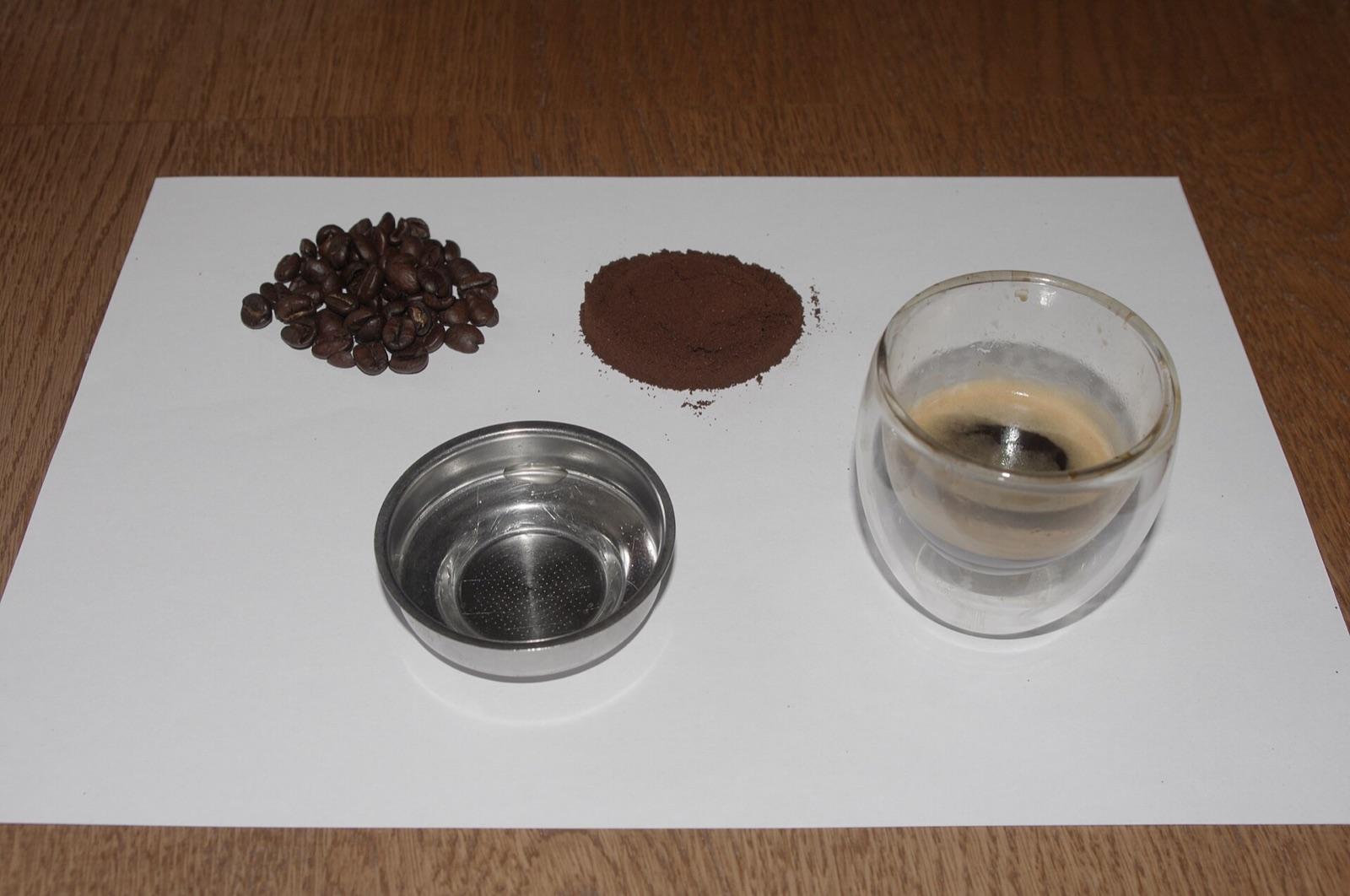
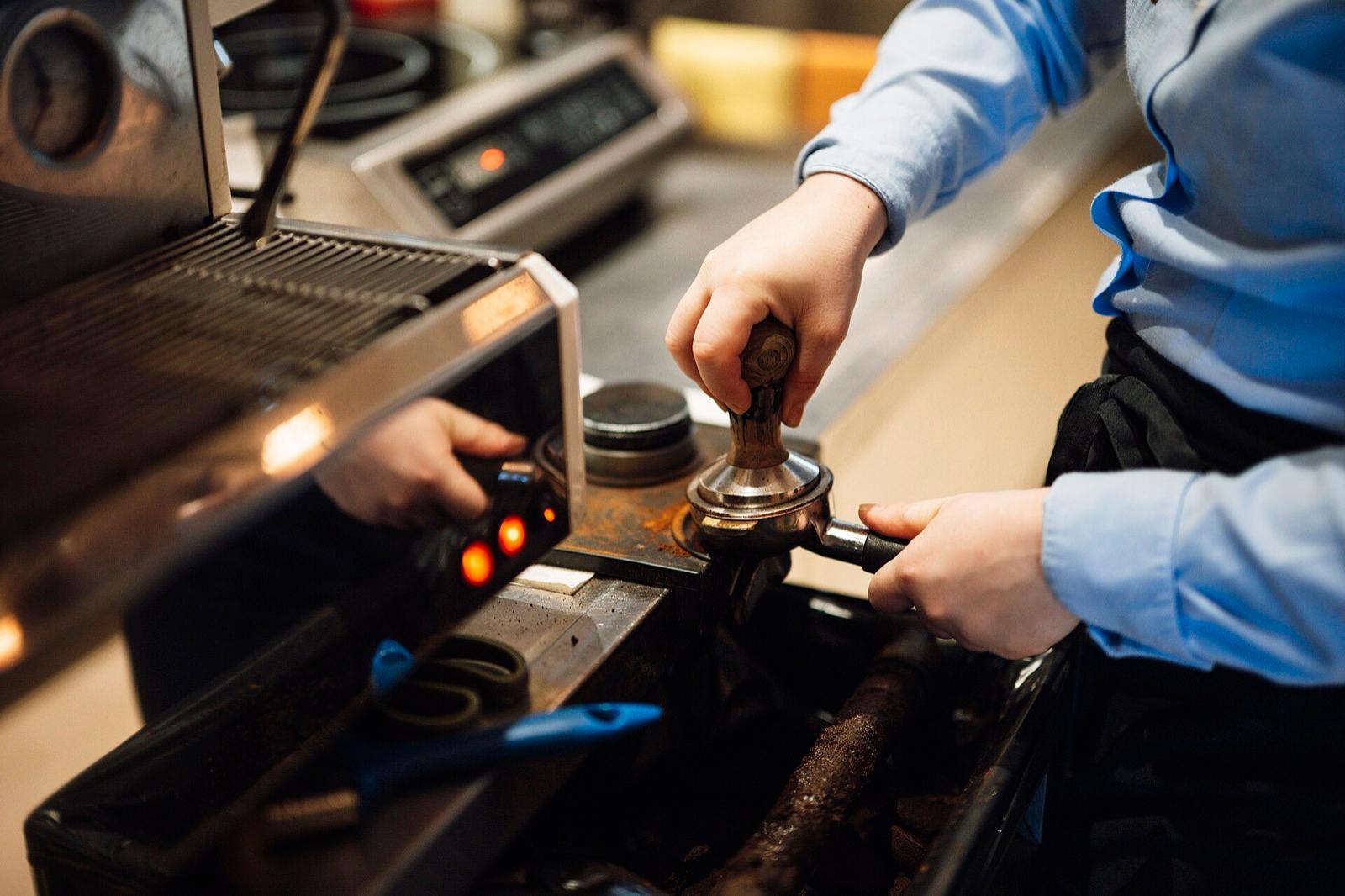
Tip the grounds into the basket, settle them level, and press down with the tamper until the bed is firm and flat. The aim is a puck with no loose edges or cracks, so water meets the same resistance everywhere.
Breville's Dual Boiler manual lists a pressure gauge not reaching 9 bars as a symptom of coffee not tamped firmly enough, which shows how directly tamping feeds into pressure. Some machines take this step over: De'Longhi's La Specialista Opera tamps with a lever at 20 kg of even pressure, Breville's Impress models assist the tamp, and the Oracle Jet tamps automatically.
Wipe stray grounds off the basket rim before you lock in, so the seal against the group gasket is clean.
Steps 5 and 6: brew at 9 bar, stop at about 36 g
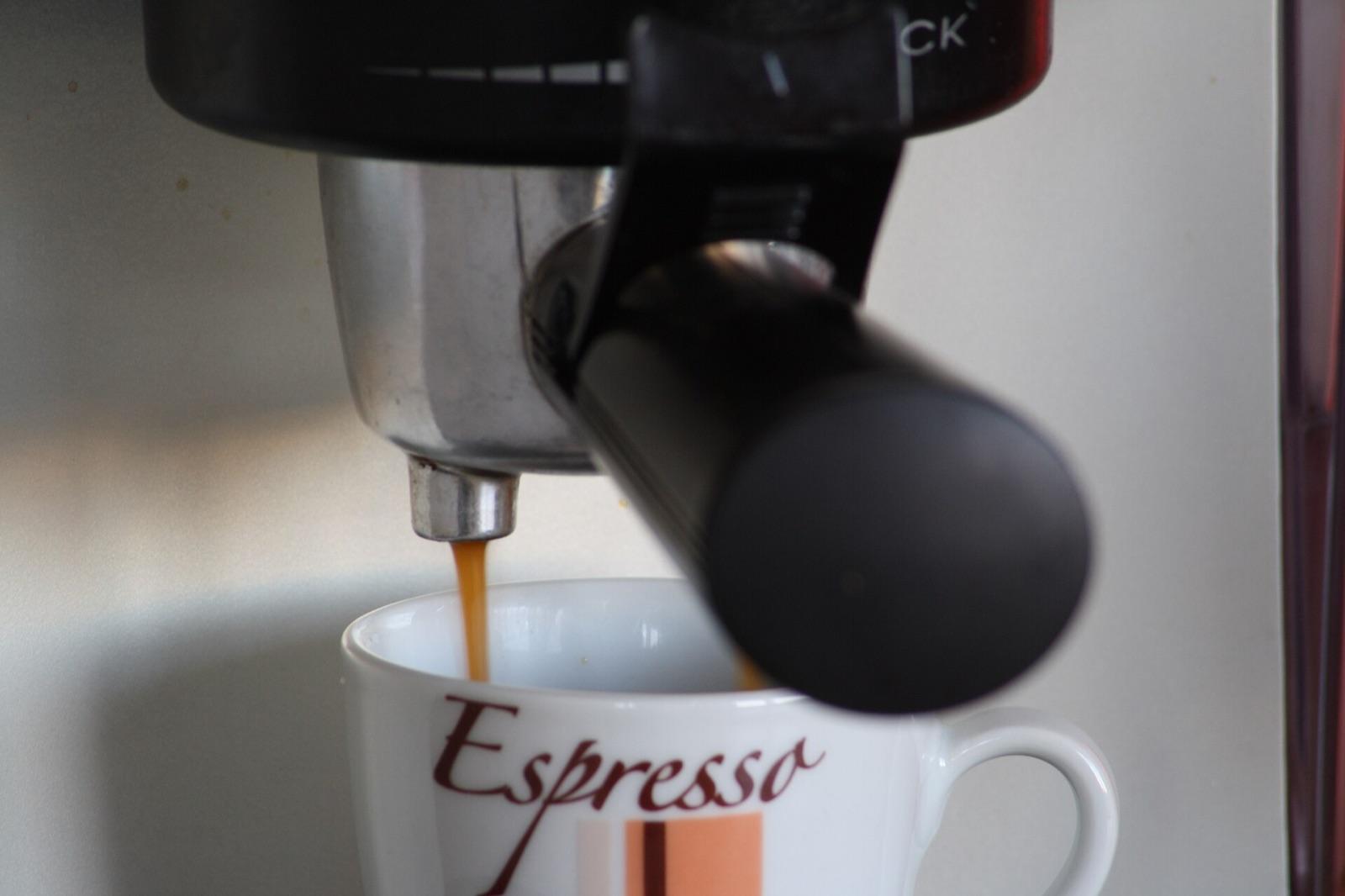
Lock the portafilter in, put a cup on a scale under it, and start the shot. Start a timer at the same moment. Baratza's recipe counts from start to finish, and INEI's 25 seconds ± 2.5 is a percolation time, so time the whole shot the same way every time.
Stop when the scale reads about twice the dose, 36 g for 18 g in, and note the time. Between 25 and 32 seconds is Baratza's target; INEI and the heritage SCAA definition sit in the same window. Many machines stop by volume on their own; Breville's 1 cup and 2 cup buttons are an example, so weigh the result at least once to see what your machine actually delivers.
About the pressure: espresso is extracted at around 9 bar. INEI sets 9 bar ± 1, the heritage SCAA definition 9–10 atmospheres, and the SCA's barista survey found an average of 8.5 bar with 9 bar the most common answer. A 15 or 20 bar figure on a box is the pump's maximum rating, not the brewing pressure; Breville's own Barista Express has a 15 bar pump and lists 9 bar extraction.
Step 7: taste, then change one thing
Taste the shot before adding anything to it. Baratza's rule is short: adjust grind finer if the shot was sour or quick; coarser if it was bitter or slow. Change the grind by one step, keep the dose and yield the same, and pull another shot. Changing two things at once makes it impossible to tell which one helped.
| What you see or taste | Likely cause | What to change |
|---|---|---|
| Sour, thin, finished well under 25 s | Grind too coarse (Breville: under-extracted) | Grind finer one step |
| Bitter, dark, slow or barely dripping | Grind too fine (Breville: over-extracted) | Grind coarser one step |
| Gauge never reaches 9 bar | Coffee not tamped firmly enough (Breville BES920) | Tamp firmer; check the dose fills the basket |
| Fast and watery with pre-ground coffee | Single wall basket with pre-ground coffee | Use the dual wall (pressurised) basket |
Using pre-ground coffee: pick the right basket
You can make espresso from pre-ground coffee, but only with the right basket. Breville's instruction books spell out the split: use single wall baskets when grinding fresh whole beans, because they let you experiment with grind, dose and tamp; use dual wall baskets with pre-ground coffee, because they regulate the pressure and help extraction regardless of grind, dose, tamp pressure or freshness.
Pressurised (dual wall) baskets come with many entry machines, including the Breville Bambino, the Gaggia Classic E24 and De'Longhi's double wall filters. If your shots run fast and watery from a bag of supermarket espresso grind, check which basket is in the portafilter before you blame the machine. When you get an espresso grinder, move to the single wall basket and the recipe above.
Turning a shot into a milk drink
Most espresso drinks start with the same shot. INEI's definition of a traditional cappuccino is 25 ml of espresso and 100 ml of steam-foamed milk, which gives you a ratio to start from even if you pull a larger home double.
To steam, purge the wand, put the tip just under the surface of cold milk in a metal jug, open the steam, and lower the jug as the milk expands; then sink the tip deeper to heat and spin the milk. Machines differ in how much they do for you: the Bambino has a manual wand, while Breville's Bambino Plus and De'Longhi's La Specialista Touch list automatic wands with adjustable temperature and texture.
If you make milk drinks back to back, the heating system matters more than the recipe; a single boiler has to switch between brew and steam temperatures, which Profitec says suits occasional milk drinkers.
Can you make espresso without an espresso machine?
Not with a moka pot, by the standards' definition. Bialetti, which makes the Moka Express, says a moka pot brews at about 1.5 bar against at least 9 bar for modern espresso machines. INEI requires 9 bar ± 1 and the heritage SCAA definition 9–10 atmospheres, so moka coffee is strong stovetop coffee rather than espresso, even when the box says otherwise.
What does reach espresso pressure without a pump machine is a manual lever press. Flair lists 9 bar brewing with a gauge on its Classic and 6–9 bar on the 49 PRO; you supply the pressure with your arm and the hot water from a kettle. Hand-pump portables such as Wacaco's Minipresso GR also exist, though Wacaco's listing does not state a brewing pressure. Our guide to espresso makers versus espresso machines covers these in detail.
Every page in this section
- Espresso Tamper Sizes
Espresso tamper sizing made simple: measure your basket, then check the portafilter size makers publish for 45 home machines, from 40 mm to 58 mm.
- Is Home Espresso Worth It?
Is home espresso worth it? Enter your café price, drinks per week and setup cost to see your cost per drink and break-even week. Worked example shown in full.
- PID Espresso Machines
PID espresso machine explained: what the controller does, when it matters by boiler type, and 28 machines showing which makers state PID and which do not.
Questions people ask
- What is the ratio for espresso?
- Baratza's simple home recipe is 1:2 by weight: 18 g of coffee in, 36 g of espresso out, in 25–32 seconds. The SCA barista survey average is close: an 18–20 g dose and 36.5 g out. INEI's Italian standard uses 7 g for 25 ml.
- How long should an espresso shot take?
- About 25 to 30 seconds. INEI sets 25 seconds ± 2.5, the heritage SCAA definition 20–30 seconds, and Baratza's recipe 25–32 seconds from start to finish.
- What temperature should the water be for espresso?
- INEI sets 88 °C ± 2 for water leaving the group; the heritage SCAA definition gives 90.5–96.1 °C. Most machines set this for you; some PID models let you change it, such as Breville's Infuser, adjustable in 4 °F steps according to Breville.
- How much caffeine is in a shot of espresso?
- USDA FoodData Central lists restaurant espresso at 212 mg per 100 g, about 63 mg per 1 fl oz shot (212 × 0.296). An 8 fl oz cup of brewed coffee has about 95 mg, so a single espresso has less caffeine per serving but more per ounce.
- Why is my espresso sour?
- Usually because it ran too fast and under-extracted. Baratza's fix is to grind finer; Breville's manual describes a too-coarse grind as giving espresso lacking colour and flavour. Keep the dose and yield the same while you adjust.
Sources & further reading
- INEI, A Brief Guide to the Italian Certified Espresso (archived PDF, 2026-11-09)
- INEI, The Certified Italian Cappuccino (archived page, 2026-11-09)
- SCA 25 Magazine, Defining the Ever-Changing Espresso (2026-11-09)
- Baratza, Dialing in Espresso (2026-11-09)
- Baratza, Switching Grind Settings with Confidence (2026-11-09)
- Breville Barista Express BES875 instruction book (2026-11-09)
- Breville Bambino BES450 US instruction book (2026-11-09)
- Breville Dual Boiler BES920 instruction book (2026-11-09)
- Breville Bambino BES450 product page (2026-11-09)
- Profitec, which Profitec espresso machine suits you (2026-11-09)
- Bialetti, How the Moka works (2026-11-09)
- Flair Classic product page (2026-11-09)
- USDA FoodData Central, espresso, restaurant-prepared (FDC 171891)
- USDA FoodData Central, brewed coffee (FDC 171890)
- Breville Infuser BES840 product page (2026-11-09)
Read next
- Espresso Tamper Sizes
Espresso tamper sizing made simple: measure your basket, then check the portafilter size makers publish for 45 home machines, from 40 mm to 58 mm.
- PID Espresso Machines
PID espresso machine explained: what the controller does, when it matters by boiler type, and 28 machines showing which makers state PID and which do not.
- Espresso Grinders
Espresso grinder guide: 14 grinders sorted by what their makers say about espresso, with burr size, settings, stepless or stepped, and a machine matcher.
- Types of Espresso Machines
Types of espresso machines sorted two ways: who grinds, tamps and stops the shot, and how the water is heated. A step-by-step table and 45 machines counted.
- Is Home Espresso Worth It?
Is home espresso worth it? Enter your café price, drinks per week and setup cost to see your cost per drink and break-even week. Worked example shown in full.
Back to the EspressoGoods home page.

EspressoGoods editors · Editorial team
EspressoGoods' catalogue and guides are compiled by the site's editorial team from espresso machine and grinder makers' own product pages, spec sheets and manuals, plus standards bodies such as the Istituto Nazionale Espresso Italiano. We do not test machines or taste shots, and we never claim to: every spec on the site links to the page it came from.
About this site · How pages are checked · Last updated November 8, 2026
As an Amazon Associate, EspressoGoods earns from qualifying purchases. It costs you nothing extra and never decides which machines we list.
EspressoGoods is an independent site. It is not affiliated with Breville, De'Longhi, Gaggia, Rancilio, Philips, Ninja or any other maker. Brand names and trademarks belong to their owners. Specs are the makers' published figures; check the maker's page before you buy.