Guide
Is Home Espresso Worth It? Run Your Own Break-Even Numbers
By EspressoGoods editors · Updated 2026-11-09 · How we research
We may earn a commission when you buy through links on this page.
Short answer
25 weeks: that is the break-even in our illustrative example (a $700 machine, $60 of extras, seven lattes a week at a $5.50 café price, beans at $18 per 340 g). Your answer depends mostly on drinks per week, your café price and the setup cost. Enter your own numbers in the calculator; if you buy fewer than three drinks a week, it may take more than a year, and a cheaper setup shortens the wait.
$31.21 a week, $760 up front, break-even in week 25: that is how one illustrative person's answer to "is home espresso worth it" comes out. The inputs are an example, not data: a $700 machine-and-grinder setup, $60 of extras, seven milk drinks a week that would otherwise cost $5.50 each at a café, and beans at $18 for a 340 g bag.
Change any of them and the answer moves, which is the point. The calculator below starts with exactly those inputs. Replace them with your own café price, your own drink count and the machine you are considering, and it recomputes cost per drink, weekly saving and the break-even week. The sections that follow show the arithmetic line by line, which inputs matter most, and what the calculation leaves out.
Setups at three price points
1. Lowest setup cost
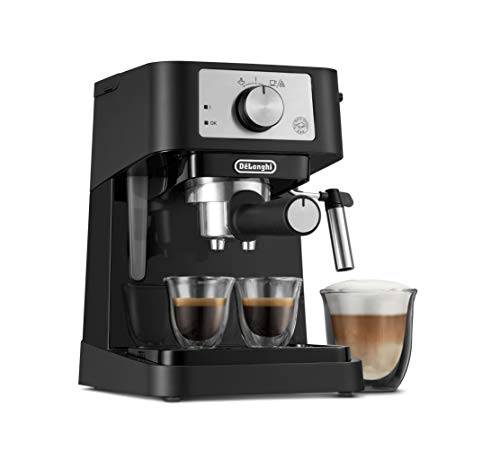
De'Longhi Stilosa
A pump machine with a manual steam wand and a 15 bar pump rating, usually under $200. With pre-ground coffee it needs no grinder, which keeps the setup figure in the calculator low.
Buy it if: Testing whether you will actually make coffee at home. Skip it if: You want temperature control; De'Longhi publishes no PID for it.
- Type
- Semi-automatic
- Heating
- Boiler (stainless steel boiler)
- Milk
- manual steam wand
- Water tank
- 33.81 oz
- Size (W×D×H)
- 13.5 x 8.07 x 11.22 in (maker label: L x W x H)
- Weight
- 10.99 lb
Specs: De'Longhi US product page (2026-11-09); De'Longhi listing on Amazon (2026-11-09)
2. Mid setup: machine now, grinder later
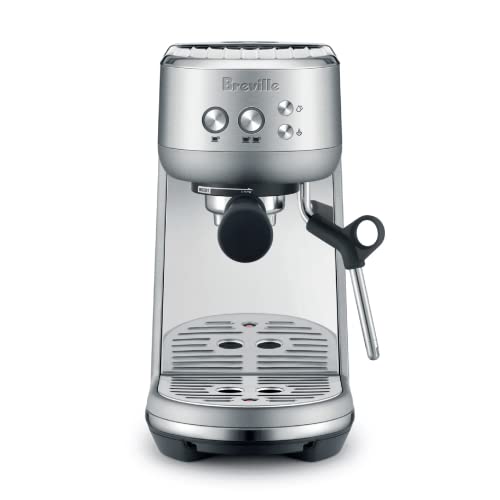
Breville Bambino
Around $300, with PID, a stated 3-second start and both dual-wall and single-wall baskets. Start with pre-ground coffee, then add a grinder when you are sure; enter each purchase as setup cost in the calculator.
Buy it if: A low first outlay with room to upgrade. Skip it if: You want milk textured automatically (Bambino Plus).
- Type
- Semi-automatic
- Heating
- ThermoJet
- PID
- Yes
- Portafilter
- 54 mm
- Milk
- steam wand (manual milk texturing)
- Heat-up (maker)
- ready to start in 3 seconds
- Water tank
- 47 fl.oz
- Size (W×D×H)
- 7.7 x 12.6 x 12.2 in (W x D x H, Breville listing on Amazon)
- Weight
- 10.42 lb
Specs: Breville US product page (2026-11-09); Breville listing on Amazon (2026-11-09)
3. The grinder to add
Baratza Encore ESP
Baratza sells the Encore ESP for espresso, with micro-steps #1–20 for espresso and 40 settings in all, around $200. Adding it lets you buy whole beans, which is the bean price the calculator assumes.
Buy it if: Moving from pre-ground to fresh beans. Skip it if: Your machine has a built-in grinder.
- Burrs
- 40mm Conical Steel (M2)
- Espresso
- Maker sells it for espresso
- Settings
- 40
- Hopper
- 300g (10.6oz)
- Size (W×D×H)
- 13 x 15 x 34 cm (W x D x H)
- Weight
- 5.56 lb
Specs: Baratza US product page (2026-11-09); Baratza listing on Amazon (2026-11-09)
4. All-in-one setup
Breville Barista Express
Machine and conical grinder in one body, with Thermocoil heating, PID and single and dual-wall baskets. Breville's list price is around $700, which is the setup figure used in the example on this page.
Buy it if: One purchase and one appliance on the counter. Skip it if: Headroom under your cabinets is tight; Breville lists it at 15.9 in tall before you open the hopper.
- Type
- Semi-automatic
- Heating
- Thermocoil
- PID
- Yes
- Grinder
- integrated conical burr grinder, steel conical burrs, 16 precision grind settings
- Portafilter
- 54 mm
- Milk
- steam wand (manual milk texturing)
- Water tank
- 67 oz; bean hopper 1/2 lb
- Size (W×D×H)
- 15.9 x 13.1 x 12.4 in as printed on Breville's page; Breville's own Amazon listing gives a 15.9 in height, so the page's first figure is the height and its W×D labelling can't be relied on
- Weight
- 22.09 lb
Specs: Breville US product page (2026-11-09); Breville listing on Amazon (2026-11-09)


Product prices and availability are accurate as of 2026-11-13 and are subject to change. Amazon prices are for the colour linked. Specs are the makers' published figures; we don't test machines.
Does home espresso pay for itself?
Put in your own prices. The starting numbers are only an example to change.
Home cost per drink
$1.04
beans $0.74 + milk $0.30
Break-even
31 weeks
about 7.1 months
After 1 year / 2 years
$663 / $2,286
saved (negative = still paying off)
Café: spend after 26 / 52 / 104 weeks
26 wk: $1,001
52 wk: $2,002
104 wk: $4,004
Home: spend after 26 / 52 / 104 weeks
26 wk: $1,149
52 wk: $1,339
104 wk: $1,718
Not counted: electricity, water filters, descaler, repairs, the drinks you'd have skipped, or the value of your time. The calculation is simple arithmetic on your inputs, shown above.
Specs are each maker's published figures (source linked per machine). Amazon prices as of 2026-11-13; prices change. We earn from qualifying purchases; it never affects matching or order, which is lowest price first.
The example, worked through the calculator's formula
The calculator uses four steps. Beans per drink is the bag price divided by its weight, times the coffee you use per drink. Home cost per drink is beans plus milk. Weekly saving is the café price minus the home cost, times the drinks you make each week. Break-even is the setup cost plus extras, divided by the weekly saving.
Here is that formula applied to the illustrative inputs. Every number below is arithmetic on the example inputs; none is a measured price.
Two outputs are worth reading together. Cost per drink tells you what each homemade latte costs once the machine is paid for, and the two-year line shows how the saving builds after break-even. The calculator also shows café spend and home spend after 26, 52 and 104 weeks side by side, so you can see when the home total falls below the café total.
| Line | Calculation | Result |
|---|---|---|
| Beans per drink | $18 ÷ 340 g × 14 g | $0.74 |
| Milk per drink | example input | $0.30 |
| Home cost per drink | $0.74 + $0.30 | $1.04 |
| Saving per drink | $5.50 − $1.04 | $4.46 |
| Weekly saving | $4.46 × 7 drinks | $31.21 |
| Setup total | $700 machine and grinder + $60 extras | $760 |
| Break-even | $760 ÷ $31.21 a week | 24.4 weeks, so week 25 (about 5.6 months) |
| After one year | $31.21 × 52 − $760 | about $863 ahead |
| After two years | $31.21 × 10⁴ − $760 | about $2,486 ahead |
Which input moves the answer most
The chart reruns the same example, changing one input at a time, so you can see what matters. Drinks per week and setup cost dominate. Bean price and dose barely move it, because beans are a small share of each drink once the setup is paid.
The weakest case is the occasional drinker. At three drinks a week, the example setup takes 57 weeks to pay back, more than a year, and after 52 weeks you would still be about $64 behind. At fourteen drinks a week, two lattes a day, it pays back in 13 weeks.
To get a figure that means something for you, fill each field from your own receipts rather than from our example:
- Setup cost: the total you will actually pay for the machine and, if needed, a grinder. Use the dropdown to load a catalogue machine's price, then add the grinder by hand.
- Extras: a tamper, milk pitcher and scale if the machine does not include them, plus any known water-filter or descaler costs for the first year.
- Drinks per week: count only the café drinks a home drink will replace. If you will still buy a coffee out on Fridays, leave that one out.
- Café price per drink: your usual order at your usual café, including any tip you normally add. A larger or flavoured drink usually costs more than a plain one, so use what you really buy.
- Bag price and bag size: from the beans you plan to buy, by weight in grams (a 12 oz bag is 340 g). The calculator divides price by weight, so a cheaper bag that is also smaller may not save anything.
- Coffee per drink: the dose you will use. A double shot in a two-cup basket is typically 16 to 19 g on Breville's Bambino, per its manual.
- Milk per drink: the cost of the milk in one drink. Divide the price of a carton by the number of drinks it makes; enter 0 for straight espresso.
What the calculation leaves out
The calculator counts beans, milk and the purchase price. It does not count electricity, water filters, descaler, repairs, or the drinks you would have skipped rather than bought. It also gives no value to your time, which for many people is the real cost of home espresso.
Maintenance is a real line, but we cannot give you a universal figure. Breville ties descaling to the machine's own indicator, and on its Dual Boiler to a water-hardness setting from 1 to 5 found with a supplied test strip. Breville also advises against distilled or demineralised water, so a filter jug or bottled water may become part of the routine. If you know your local costs for these, add them to the extras field.
None of these makes home espresso a bad deal in itself; they shrink the saving rather than reverse it, unless the machine needs an expensive repair early. If you want a cautious figure, raise the extras field by whatever you expect to spend on upkeep in the first year and watch how far the break-even week moves.
- Not counted: electricity and water.
- Not counted: descaler and water filters, which depend on your water hardness and machine.
- Not counted: repairs and replacement parts such as gaskets.
- Not counted: wasted coffee while you learn to dial in.
- Not counted: the coffees you would have skipped instead of buying.
The setup you need to price in
The setup figure is where most estimates go wrong, because people price the machine and forget the rest. A pump machine is the start. If it uses single-wall baskets, you also need a grinder that goes fine enough for espresso; Breville says dual-wall baskets are for pre-ground coffee and regulate pressure regardless of grind, so they let you defer the grinder. Then come small tools: a tamper, a milk pitcher for steaming, and a scale for weighing doses. The calculator's extras field defaults to $60 for these as an example.
In our catalogue, that gives three typical setups. A De'Longhi Stilosa with pre-ground coffee keeps setup under $200 plus extras. A Breville Bambino at around $300 plus a Baratza Encore ESP at around $200 lands near $500. An all-in-one Breville Barista Express sits around $700 at Breville's list price. Check the live prices on the cards, then put your real total into the calculator rather than our bands.
Resale value is the one cost the calculator cannot see in your favour. A machine you stop using still has some value, so the downside of trying home espresso is smaller than the full setup cost. We do not estimate resale prices, because they vary by model and condition and we have no sourced data for them.
Worth it for more than money?
Owners on r/espresso argue both sides, and their threads are a useful reality check on the numbers. Some point to café prices; others question whether the saving is the point at all. Treat these as opinions, not data.
Three non-money questions decide whether home espresso is worth it for you. Do you enjoy a routine that takes a few minutes and some learning? Will the machine replace café visits, or will you still go out and drink both? And do you mainly drink milk drinks, where home setups save the most per cup, or plain espresso, where there is no milk to make and your café price may be lower?
If the honest answer is that you buy coffee out for the break and the walk, not the drink, a machine will not replace that, and the calculator's saving will not appear.
I definitely think so! A cappuccino at a cafe these days costs $5 or more.
— r/espresso user (owner's opinion), thread "Home espresso will save you money?", April 2025 (quoted from the thread's search snippet)
When it is not worth it
Run the numbers honestly and some cases fail. Home espresso is unlikely to pay off within a year if you buy fewer than about three drinks a week at today's prices, if your café price is low and your setup is expensive, or if you will keep buying out as often as before.
It also fails if the machine is wrong for the drinks you buy. A latte drinker who buys a machine with no steam wand, or an espresso drinker who buys an expensive super-automatic, pays for features that do not replace their café order. Match the machine to the drink first, then run the calculator with that machine's price.
A cautious way to start is to keep the setup small: a machine with dual-wall baskets and pre-ground coffee, entered in the calculator at its real price. If after a couple of months you are making the drinks you expected, the break-even is close or behind you and a grinder becomes an easy upgrade to justify. If not, you have spent far less than on an all-in-one.
So is home espresso worth it? For a daily milk-drink buyer with a modest setup, the example says yes within months. For an occasional buyer with an expensive setup, it says not for a year or more. Put in your own numbers and copy the result link to keep it.
Questions people ask
- How long does it take for an espresso machine to pay for itself?
- It depends on your numbers. In our illustrative example ($760 setup, seven $5.50 drinks a week) it takes 25 weeks. At three drinks a week it takes 57 weeks; at fourteen, 13. Enter your own inputs in the calculator.
- How much does a homemade latte cost?
- With the example inputs ($18 per 340 g of beans, 14 g per drink, $0.30 of milk), about $1.04 per drink. Your cost depends on your beans, dose and milk; the calculator shows the breakdown.
- Is a cheap espresso machine worth it?
- A low setup cost pays back fastest: in the example, a $300 setup breaks even in 12 weeks against 25 for $700. The trade-off is features such as PID, automatic milk or a built-in grinder, which you may want later.
- Do I need a grinder to save money with home espresso?
- No. A machine with dual-wall baskets works with pre-ground coffee, which Breville recommends for those baskets. A grinder adds to setup cost but lets you buy whole beans and use single-wall baskets.
- What costs does the calculator not include?
- Electricity, water, filters, descaler, repairs, wasted coffee while learning, and the value of your time. Add known extras to the extras field to include them.
Sources & further reading
- Breville Bambino BES450 instruction book: basket capacities and dual-wall baskets (2026-11-09)
- Breville Barista Express BES875 instruction book: descaling and water (2026-11-09)
- Breville Dual Boiler BES920 instruction book: water hardness setting (2026-11-09)
- INEI, A Brief Guide to the Italian Certified Espresso (archived PDF, read 2026-11-09)
- Breville Barista Express BES870 product page (2026-11-09)
- Breville Bambino BES450 product page (2026-11-09)
- De'Longhi Stilosa EC260BK product page (2026-11-09)
- Baratza Encore ESP product page (2026-11-09)
- r/espresso thread "Home espresso will save you money?" (owner opinions, 2025)
- r/espresso thread "When is home espresso-ing worth it?" (owner opinions, 2023)
Read next
- How to Make Espresso
How to make espresso at home, step by step: INEI and SCAA parameters, an 18 g in, 36 g out recipe, grind, tamp and timing, and fixes when a shot tastes off.
- Budget Espresso Machines
Best budget espresso machine picks from about $110 to $500, sorted by what each price step adds: PID, basket type, portafilter size and the grinder you need.
- Espresso Machines Under $500
Best espresso machine under 500 dollars, with the grinder counted: five ways to split $500, spec tables from makers' pages, and the 54 vs 58 mm question.
- Espresso Grinders
Espresso grinder guide: 14 grinders sorted by what their makers say about espresso, with burr size, settings, stepless or stepped, and a machine matcher.
- Espresso Machines for Lattes
Best espresso machine for lattes by milk system: manual wand, automatic wand, carafe or whisk, plus boiler type for back-to-back drinks. Maker specs only.
- Breville Espresso Machines
Breville espresso machines compared rung by rung, Bambino to Oracle Jet: heater, PID, grinder settings, milk system and height from Breville's own spec pages.
Part of How to Make Espresso. Back to the EspressoGoods home page.

EspressoGoods editors · Editorial team
EspressoGoods' catalogue and guides are compiled by the site's editorial team from espresso machine and grinder makers' own product pages, spec sheets and manuals, plus standards bodies such as the Istituto Nazionale Espresso Italiano. We do not test machines or taste shots, and we never claim to: every spec on the site links to the page it came from.
About this site · How pages are checked · Last updated November 9, 2026
As an Amazon Associate, EspressoGoods earns from qualifying purchases. It costs you nothing extra and never decides which machines we list.
EspressoGoods is an independent site. It is not affiliated with Breville, De'Longhi, Gaggia, Rancilio, Philips, Ninja or any other maker. Brand names and trademarks belong to their owners. Specs are the makers' published figures; check the maker's page before you buy.