Guide
Best Espresso Machine for Beginners: A Step-by-Step Way to Choose
By EspressoGoods editors · Updated 2026-11-09 · How we research
We may earn a commission when you buy through links on this page.
Short answer
Start with the Breville Bambino: Breville lists PID temperature control, a 3-second heat-up, and both pressurised and single-wall baskets, so it forgives pre-ground coffee on day one and grows with a grinder later. Pair it with an espresso-capable grinder such as the Baratza Encore ESP. If you want no learning curve at all, choose a push-button super-automatic instead.
"[US] Good beginner espresso maker/machine under $300 ballpark" is how one r/espresso owner asked for the best espresso machine for beginners, and the replies show the problem every first-timer meets: dozens of answers, each from someone who already knows how to dial in a shot. A beginner needs a different question answered first: which machine forgives the mistakes I will make in week one, and which one will I still be happy with in year two?
This guide gives you a six-step path to an answer, a finder tool preset for beginner budgets, a costed table of full setups (because the grinder is part of the price), and six picks chosen from makers' published specs. Nothing here is based on our own shots; every spec is the maker's, with sources at the bottom.
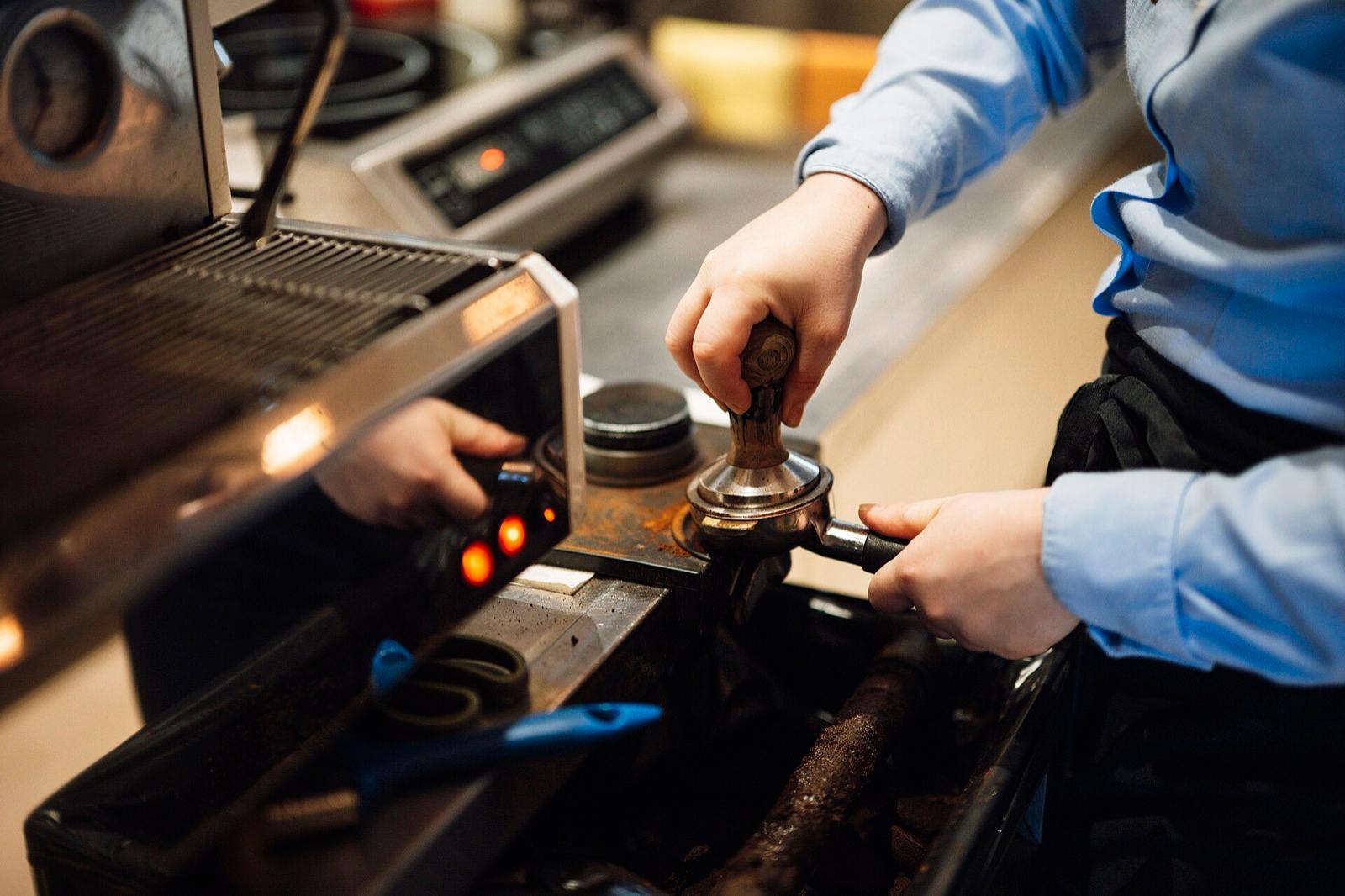
Beginner picks, from easiest start to most room to grow
1. Best first machine overall
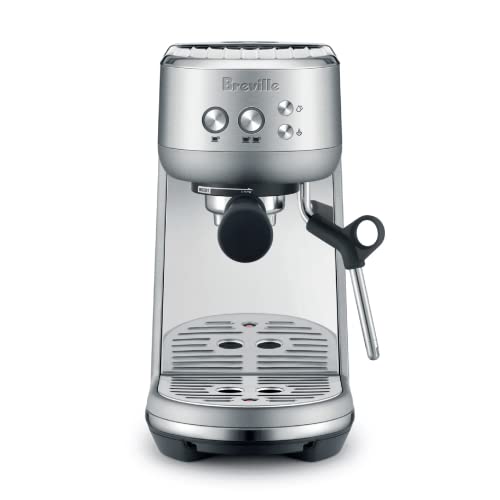
Breville Bambino
Breville lists a ThermoJet heater ready in 3 seconds, PID temperature control and both single-wall and dual-wall 54 mm baskets. The dual-wall baskets handle pre-ground coffee while you save for a grinder.
Buy it if: First-timers who want to learn real espresso in a 7.7 in wide machine. Skip it if: You want milk steamed for you; the Bambino's wand is manual.
- Type
- Semi-automatic
- Heating
- ThermoJet
- PID
- Yes
- Portafilter
- 54 mm
- Milk
- steam wand (manual milk texturing)
- Heat-up (maker)
- ready to start in 3 seconds
- Water tank
- 47 fl.oz
- Size (W×D×H)
- 7.7 x 12.6 x 12.2 in (W x D x H, Breville listing on Amazon)
- Weight
- 10.42 lb
Specs: Breville US product page (2026-11-09); Breville listing on Amazon (2026-11-09)
2. Best beginner machine for milk drinks
Breville Bambino Plus
The Bambino's heater, PID and baskets, plus an automatic steam wand with adjustable milk temperature and texture, per Breville. The tank is larger: 64 fl oz against the Bambino's 47.
Buy it if: Beginners who drink lattes and do not want to learn steaming first. Skip it if: You drink straight espresso; the extra cost buys mostly milk automation.
- Type
- Semi-automatic
- Heating
- ThermoJet
- PID
- Yes
- Portafilter
- 54 mm
- Milk
- automatic steam wand (hands-free milk texturing)
- Heat-up (maker)
- ready to start in 3 seconds
- Water tank
- 64 fl.oz
- Size (W×D×H)
- 7.7 x 12.5 x 12.2 in (W x D x H, Breville listing on Amazon: 'a width of 7.7 inches')
- Weight
- 10.91 lb
Specs: Breville US product page (2026-11-09); Breville listing on Amazon (2026-11-09)
3. Best beginner all-in-one
Breville Barista Express
Breville lists an integrated conical grinder with 16 settings, a Thermocoil heater with PID, a pressure gauge and single- and dual-wall baskets. One box covers grinding and brewing.
Buy it if: Beginners who want one appliance and a gauge that shows what the shot is doing. Skip it if: Your wall cabinets are low: Breville lists it at 15.9 in tall before you open the bean hopper.
- Type
- Semi-automatic
- Heating
- Thermocoil
- PID
- Yes
- Grinder
- integrated conical burr grinder, steel conical burrs, 16 precision grind settings
- Portafilter
- 54 mm
- Milk
- steam wand (manual milk texturing)
- Water tank
- 67 oz; bean hopper 1/2 lb
- Size (W×D×H)
- 15.9 x 13.1 x 12.4 in as printed on Breville's page; Breville's own Amazon listing gives a 15.9 in height, so the page's first figure is the height and its W×D labelling can't be relied on
- Weight
- 22.09 lb
Specs: Breville US product page (2026-11-09); Breville listing on Amazon (2026-11-09)
4. Best low-cost start
CASABREWS CM5418
CASABREWS lists a thermoblock single boiler, PID temperature control, a built-in pressure gauge and a 51 mm portafilter with one- and two-cup filters. The pump is rated at 20 bar, which is a maximum, not brew pressure.
Buy it if: Testing whether you like home espresso before spending more. Skip it if: You want common accessories; 51 mm is a less widely supported size than 54 or 58 mm.
- Type
- Semi-automatic
- Heating
- Thermoblock Single Boiler
- PID
- Yes
- Portafilter
- 51 mm
- Milk
- steam wand
- Water tank
- 34 oz (up to 10 cups)
- Size (W×D×H)
- 5.9'' x 11.97'' x 12.28'' (order not stated)
- Weight
- 8.6 lb
Specs: CASABREWS US product page (2026-11-09); CASABREWS listing on Amazon (2026-11-09)
5. Best push-button option
De'Longhi Magnifica Evo (LatteCrema)
A super-automatic: De'Longhi lists a 13-setting conical grinder, a LatteCrema automatic milk carafe and 7 one-touch drinks. You add beans and water and press a button.
Buy it if: Households that want espresso drinks without learning grind, dose or tamp. Skip it if: You want to learn to dial in; a super-automatic makes those choices for you.
- Type
- Super-automatic (bean to cup)
- Heating
- Thermoblock
- Grinder
- conical burr, 13 grind settings
- Milk
- LatteCrema System (automatic milk frother, carafe)
- Water tank
- 60.87 oz
- Size (W×D×H)
- 9.4 x 17.3 x 14.2 in (maker label: L x W x H)
- Weight
- 26.28 lb
Specs: De'Longhi US product page (2026-11-09); De'Longhi listing on Amazon (2026-11-09)
6. Grinder to pair with a first machine
Baratza Encore ESP
Baratza lists 40 mm M2 conical burrs and a dual-range dial: steps 1–20 are micro-steps for espresso, 21–40 macro-steps for filter. That puts most of the adjustment where espresso needs it.
Buy it if: Bambino, Bambino Plus or CASABREWS owners moving off pre-ground coffee. Skip it if: You chose an all-in-one or a super-automatic, which already grind.
- Burrs
- 40mm Conical Steel (M2)
- Espresso
- Maker sells it for espresso
- Settings
- 40
- Hopper
- 300g (10.6oz)
- Size (W×D×H)
- 13 x 15 x 34 cm (W x D x H)
- Weight
- 5.56 lb
Specs: Baratza US product page (2026-11-09); Baratza listing on Amazon (2026-11-09)




Product prices and availability are accurate as of 2026-11-13 and are subject to change. Amazon prices are for the colour linked. Specs are the makers' published figures; we don't test machines.
Find the espresso machines that fit you
Answer what matters; leave the rest on “Any”. Matching uses only the makers' published specs and today's prices.
Wacaco Minipresso GR
Portable · No heater
Why it fits: $46.90 (Amazon 2026-11-13)
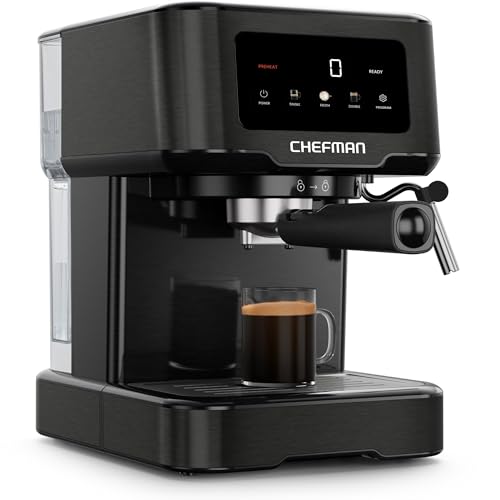
Chefman CraftBrew Espresso Machine
Semi-automatic · 8.9 in wide
Why it fits: $79.97 (Amazon 2026-11-13)
CASABREWS 3700 Essential
Semi-automatic · Flash heater · 51 mm
Why it fits: $99.99 (Amazon 2026-11-13)
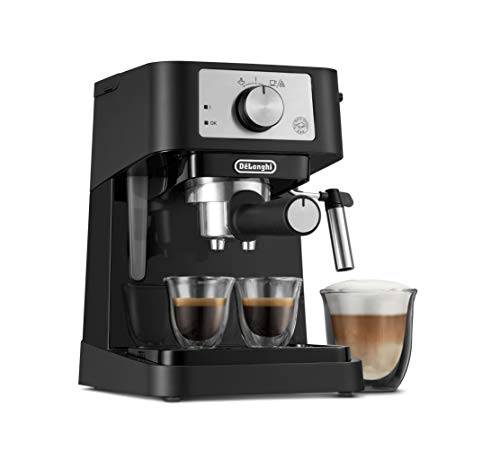
De'Longhi Stilosa
Semi-automatic · Single boiler · 8.07 in wide
Why it fits: $139.95 (Amazon 2026-11-13)
CASABREWS CM5418
Semi-automatic · Flash heater · 51 mm
Why it fits: $139.99 (Amazon 2026-11-13)
De'Longhi Classic (sold on Amazon as Classic Signature)
Semi-automatic · Flash heater · 9 in wide
Why it fits: $149.95 (Amazon 2026-11-13)
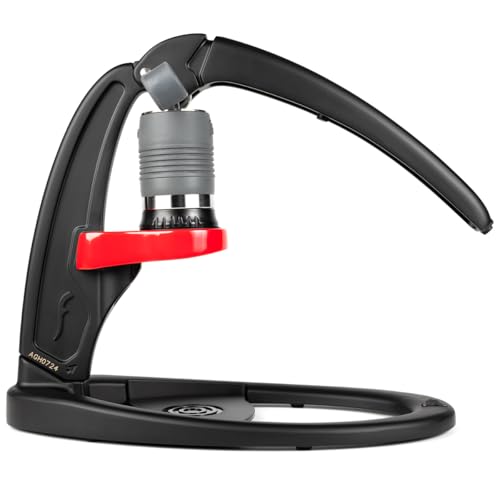
Flair Classic
Manual lever · No heater · 40 mm · 6.25 in wide
Why it fits: $159 (Amazon 2026-11-13)
CASABREWS 5418 PRO
Semi-automatic · Flash heater · 5.9 in wide
Why it fits: $161 (Amazon 2026-11-13)
CASABREWS Ultra
Semi-automatic · Flash heater · 58 mm · 10.31 in wide
Why it fits: $209.99 (Amazon 2026-11-13)
Breville Bambino
Semi-automatic · Flash heater · 54 mm · 7.7 in wide
Why it fits: $299.95 (Amazon 2026-11-13)
CASABREWS Marenza
Semi-automatic · Flash heater · 58 mm · 8.9 in wide
Why it fits: $299.99 (Amazon 2026-11-13)
Flair 49 PRO
Manual lever · No heater · 49 mm · 7.5 in wide
Why it fits: $359 (Amazon 2026-11-13)





Showing the 12 lowest-priced matches. Narrow an answer, or open the compare tab to see all of them.
Near misses (one requirement short)
- Gaggia Classic Evo Pro $529.99 · missing: under $500
- Philips 3300 Series LatteGo $544.36 · missing: under $500
- De'Longhi Magnifica Evo (LatteCrema) $549.95 · missing: under $500
- Ninja Luxe Café Premier $599 · missing: under $500
Specs are each maker's published figures (source linked per machine). Amazon prices as of 2026-11-13; prices change. We earn from qualifying purchases; it never affects matching or order, which is lowest price first.
Six steps to your first espresso machine
Work through these in order. Steps one and two decide the category; steps three to six narrow it to a model.
The finder below is preset to a $500 budget with every other filter open. Change the drinks filter to milk if most of your coffee is lattes, set grinder to built-in if you want one appliance, and narrow the width filter if counter space is tight. Each result links to the maker's specs and shows the live price.
- Decide how much you want to learn. If the answer is 'nothing, just give me a latte', go straight to a push-button super-automatic and skip to step five.
- Check what coffee you will use in month one. Pre-ground only? You need a machine that ships with dual-wall (pressurised) baskets. Fresh beans? You need an espresso-capable grinder, either built in or separate.
- Set the total budget, then subtract the grinder. A machine that leaves nothing for a grinder will be stuck on pre-ground coffee.
- Pick milk handling: a manual steam wand (cheaper, slower to learn) or an automatic wand that textures milk for you.
- Measure the counter: width, depth and the clearance under any wall cabinet.
- Use the finder below with your answers, then compare two or three results side by side on live prices.
Pressurised baskets: the safety net, and its limit
The most beginner-friendly feature on a spec sheet is not heat-up speed or pump bar. It is the basket set. Breville's manual says dual-wall filter baskets 'regulate the pressure and help to optimise the extraction regardless of the grind, dose, tamp pressure or freshness', and tells owners to use them with pre-ground coffee. Single-wall baskets are for freshly ground beans and 'allow you to experiment with grind, dose and tamp'.
That is why the Bambino, Bambino Plus and Barista Express ship with both. A beginner can start on pre-ground coffee in the dual-wall basket, then move to the single-wall basket once a grinder arrives, without changing machines. De'Longhi's Stilosa lists its filter type as a 'Crema disk'; De'Longhi's page does not describe single-wall baskets for it.
The limit: a pressurised basket hides grind problems instead of teaching you to fix them. If you want to learn espresso properly, plan the move to single-wall baskets within a few months, and budget the grinder that move requires.
What does a full beginner setup cost?
Every row below is a complete setup that can make espresso from day one. Price bands come from each maker's list price on 9 November 2026; live prices on the cards often differ, sometimes by a lot.
| Setup | Machine band | Grinder | Baskets for pre-ground? | Milk | What you learn |
|---|---|---|---|---|---|
| De'Longhi Stilosa + pre-ground coffee | under $150 | none (pre-ground) | Crema disk filter | Manual wand | Steaming; little dialling in |
| CASABREWS CM5418 + Baratza Encore ESP | around $140 + around $200 | Separate, 40-step dial | Not stated by maker | Manual wand | Grind, dose, gauge reading |
| Breville Bambino + Baratza Encore ESP | around $300 + around $200 | Separate, 40-step dial | Yes, dual-wall | Manual wand | Full espresso workflow |
| Breville Bambino Plus + Baratza Encore ESP | around $500 + around $200 | Separate, 40-step dial | Yes, dual-wall | Automatic wand | Espresso; milk done for you |
| Breville Barista Express | around $700 list | Built in, 16 settings | Yes, dual-wall | Manual wand | Full workflow in one box |
| De'Longhi Magnifica Evo | around $550 | Built in, 13 settings | Not applicable | Automatic carafe | Very little: push-button |
Semi-automatic or push-button: an honest split
A semi-automatic (Bambino, Barista Express, CASABREWS, Stilosa) leaves you in charge of grinding, dosing, tamping and stopping the shot, with some automation for shot volume on models that list it. A super-automatic such as the Magnifica Evo grinds, doses, tamps and brews internally; De'Longhi lists 7 one-touch drinks and an automatic milk carafe.
Neither is the 'beginner' answer by default. If the appeal of espresso is the ritual and the control, a super-automatic will feel like a coffee vending machine. If the appeal is a decent latte at 7 a.m. with no thinking, a semi-automatic will feel like homework. Pick by which description sounds like you, then use the finder's effort filter to show only that category.
Two practical differences matter once the machine is home. A super-automatic is larger: De'Longhi lists the Magnifica Evo at 17.3 in on one axis and 14.2 in tall, against the Bambino's 7.7 in width and 12.2 in height. And cleaning differs: a semi-automatic needs the portafilter knocked out and the wand wiped after each use, while a super-automatic collects used pucks internally and asks for its own cleaning routines. Read the maker's cleaning section in the manual before choosing, because that is the work you will do every day.
Ignore these on the box
Three claims sell beginner machines and tell you little about how easy they are to use.
- A big pump number. 15 and 20 bar are pump ratings. The Istituto Nazionale Espresso Italiano lists 9 bar ± 1 as a condition for certified espresso, and Breville's own Bambino spec line reads 'low pressure pre-infusion followed by 9 bar extraction; 15 bar Italian pump'. A 20-bar machine does not brew at 20 bar.
- 'Café-style' or similar marketing in a product title. Read the spec list for basket type, temperature control and grinder instead.
- Calling a moka pot an espresso maker. Bialetti says its moka brews at about 1.5 bars, against at least 9 bars for espresso machines. A moka makes strong stovetop coffee, not espresso.
Your first week, step by step
Makers publish clear starting points, and following one recipe consistently teaches more than changing everything at once. This is a routine built from Breville's and Baratza's published guidance.
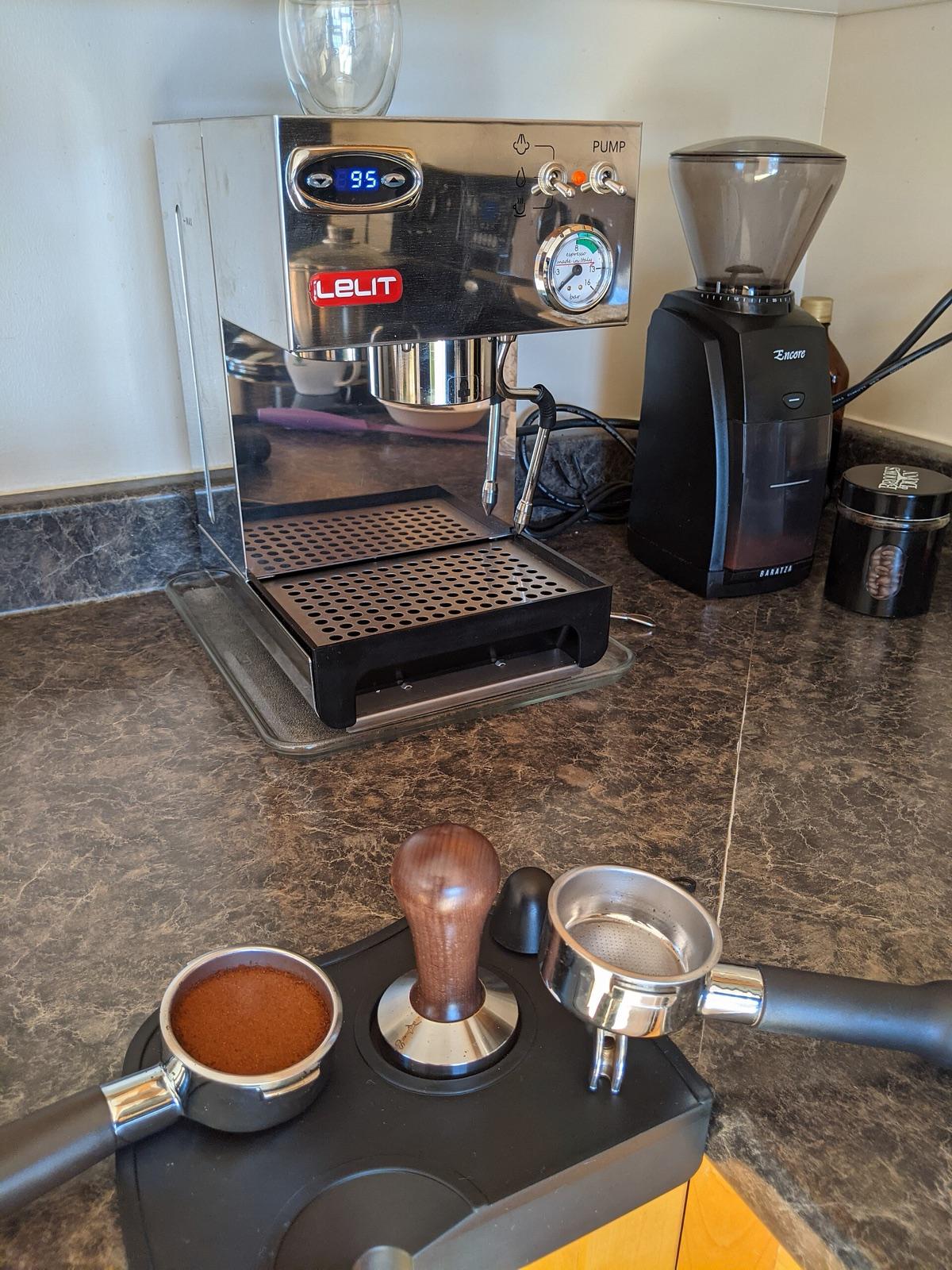
- Run water through the empty machine and portafilter to heat the group, following the machine's manual.
- Weigh the dose. Breville's Bambino manual gives 16–19 g for its 2-cup basket; Baratza's starter recipe uses 18 g.
- Aim for about twice the dose out: Baratza suggests 36 g of espresso in 25–32 seconds from start to finish.
- Taste, then change one thing. Baratza's rule: 'Adjust grind finer if sour/quick; coarser if bitter/slow.'
- Repeat with the same beans until two shots in a row taste similar, then change beans.
- Descale when the machine's indicator asks for it; Breville ties descaling to its indicator rather than a fixed calendar, and advises against distilled water.
When a beginner machine is the wrong buy
A first machine fails for predictable reasons, and most have nothing to do with the machine itself. Fresh beans ground on a blade grinder or a filter-only burr grinder will not get fine or even enough for a single-wall basket; Breville describes too-coarse coffee as running through 'too quickly' and producing an under-extracted shot. Baratza positions its original Encore for filter brewing, which is why the Encore ESP exists.
Space is the second failure. The Barista Express stands 15.9 in tall by Breville's own Amazon listing, against 12.2 in for the Bambino, and Breville's published width and depth for it conflict, so measure one in a store before planning a tight spot. A separate grinder adds another box beside a small machine. Measure before you buy, including the space a top-fill tank or hopper needs under a wall cabinet.
The third is buying for a hobby you may not keep. If you are unsure, a low-cost machine with a pressure gauge, such as the CASABREWS CM5418, or a push-button machine for zero effort, is a cheaper way to find out than the best espresso machine for beginners on someone else's list. You can always sell up later.
Questions people ask
- What is the easiest espresso machine for a beginner to use?
- A super-automatic such as the De'Longhi Magnifica Evo is the easiest, because it grinds, doses and brews at the press of a button. Among semi-automatics, the Bambino Plus is the simplest, since Breville's automatic wand textures milk for you.
- Should a beginner buy a machine with a built-in grinder?
- Only if you value one appliance over upgrade options. The Barista Express lists 16 grind settings; a separate grinder such as the Encore ESP gives 20 micro-steps for espresso alone and can be replaced later without changing the machine.
- Can I use pre-ground coffee in a beginner espresso machine?
- Yes, with a dual-wall (pressurised) basket. Breville tells owners to use dual-wall baskets with pre-ground coffee and single-wall baskets with freshly ground beans.
- Is the Breville Bambino good for beginners?
- It is the most common recommendation for a reason: Breville lists a 3-second heat-up, PID temperature control and both basket types in a 7.7 in wide body. Its steam wand is manual, so milk takes practice.
- Is a 20-bar espresso machine better than a 15-bar one?
- No. The bar figure is the pump's maximum rating. Espresso standards put extraction at about 9 bar (INEI 9 bar ± 1; the heritage SCAA definition, 9–10 atmospheres).
- How much should a beginner spend on an espresso machine?
- Plan the total, not the machine. A Bambino plus an Encore ESP sits around $500 at list prices; under $200, a De'Longhi Stilosa with pre-ground coffee is the simplest start. Check live prices, which often differ from list.
- Do beginners need a scale?
- It helps a lot. Breville gives basket capacities in grams and Baratza's starter recipe is 18 g in, 36 g out, so a scale is the only way to follow them consistently.
- What is the best espresso machine for beginners on a budget?
- Under about $150, the De'Longhi Stilosa or the CASABREWS CM5418. The CASABREWS lists PID and a pressure gauge; the Stilosa lists a stainless boiler and a manual wand. Neither includes a grinder.
- Is a manual lever machine good for a first espresso machine?
- It can be, but a lever such as the Flair Classic adds a skill on top of grinding and dosing: you apply the pressure by hand instead of a pump doing it. Flair lists a 60 ml water capacity on the Classic, so it makes one shot at a time and has no steam wand.
Sources & further reading
- r/espresso: [US] Good beginner espresso maker/machine under $300 ballpark (thread title quoted)
- Breville Bambino product page (2026-11-09)
- Breville Bambino BES450 US instruction book (baskets, dose)
- Breville Bambino Plus product page (2026-11-09)
- Breville Barista Express product page (2026-11-09)
- Breville Barista Express BES875 instruction book (baskets, grind, descaling)
- CASABREWS CM5418 product page (2026-11-09)
- De'Longhi Stilosa US product page (2026-11-09)
- De'Longhi Magnifica Evo US product page (2026-11-09)
- Baratza Encore ESP product page (2026-11-09)
- Baratza: Dialing in espresso
- INEI certified Italian espresso guide (archive copy)
- Bialetti: How the Moka works
Read next
- Espresso Machines Under $500
Best espresso machine under 500 dollars, with the grinder counted: five ways to split $500, spec tables from makers' pages, and the 54 vs 58 mm question.
- Espresso Machines Under $200
Best espresso machine under 200 dollars, without the myths: why 20-bar labels mislead, what pressurised baskets do, and six picks with makers' published specs.
- Bambino vs Bambino Plus
Breville Bambino vs Bambino Plus: same ThermoJet heater, PID and 54 mm baskets; the Plus adds automatic milk texturing and a larger tank. See the full diff.
- Baratza Encore ESP
Baratza Encore ESP explained from Baratza's specs: 40 mm M2 conical burrs, 20 espresso micro-steps, how it compares with the Encore, ESP Pro and rivals.
- How to Make Espresso
How to make espresso at home, step by step: INEI and SCAA parameters, an 18 g in, 36 g out recipe, grind, tamp and timing, and fixes when a shot tastes off.
- Super-Automatic Espresso Machines
Super automatic espresso machine picks from De'Longhi, Philips, Jura and Ninja, compared by milk system, grind steps, cleaning claims and counter depth.
Part of Budget Espresso Machines. Back to the EspressoGoods home page.
EspressoGoods editors · Editorial team
EspressoGoods' catalogue and guides are compiled by the site's editorial team from espresso machine and grinder makers' own product pages, spec sheets and manuals, plus standards bodies such as the Istituto Nazionale Espresso Italiano. We do not test machines or taste shots, and we never claim to: every spec on the site links to the page it came from.
About this site · How pages are checked · Last updated November 9, 2026
As an Amazon Associate, EspressoGoods earns from qualifying purchases. It costs you nothing extra and never decides which machines we list.
EspressoGoods is an independent site. It is not affiliated with Breville, De'Longhi, Gaggia, Rancilio, Philips, Ninja or any other maker. Brand names and trademarks belong to their owners. Specs are the makers' published figures; check the maker's page before you buy.