Guide
Super Automatic Espresso Machine Picks, Compared by Milk System
By EspressoGoods editors · Updated 2026-11-08 · How we research
We may earn a commission when you buy through links on this page.
Short answer
Milk drinks on a budget point to the De'Longhi Magnifica Evo (LatteCrema carafe, 13 grind settings); Philips says the 3300 LatteGo's milk part is the simplest to clean. The Rivelia has two bean hoppers. The Jura E4 has no milk system, so it suits straight espresso. All trade grind and tamp control for one button.
Here is the trade a super automatic espresso machine asks of you, said plainly: it takes away almost every decision, and with them almost every way to fix a shot you don't like. You cannot change the tamp, swap a basket or time the pour yourself. In return, beans go in the top and a latte comes out the front at the press of a button, every morning, for anyone in the house.
Whether that trade is worth it depends on what you drink, so this page is built around the part that differs most between models: the milk system. The picks and the table use each maker's own spec page, read on 9 November 2026, and every speed or cleaning claim is attributed to the maker that makes it. Philips and JURA do not publish US list prices on their spec pages, so the cards show live prices instead of a figure in the text.
Super-automatic picks by what you drink
1. Best value for milk drinks
De'Longhi Magnifica Evo (LatteCrema)
De'Longhi lists a conical burr grinder with 13 settings, the LatteCrema System with a milk carafe, a 1.8 L tank and seven one-touch drinks including iced coffee. It has the lowest list price of the super-automatics in our catalogue whose makers publish one.
Buy it if: Lattes and cappuccinos without learning anything. Skip it if: You want a long drink menu or user profiles.
- Type
- Super-automatic (bean to cup)
- Heating
- Thermoblock
- Grinder
- conical burr, 13 grind settings
- Milk
- LatteCrema System (automatic milk frother, carafe)
- Water tank
- 60.87 oz
- Size (W×D×H)
- 9.4 x 17.3 x 14.2 in (maker label: L x W x H)
- Weight
- 26.28 lb
Specs: De'Longhi US product page (2026-11-09); De'Longhi listing on Amazon (2026-11-09)
2. Easiest milk part to clean (per Philips)
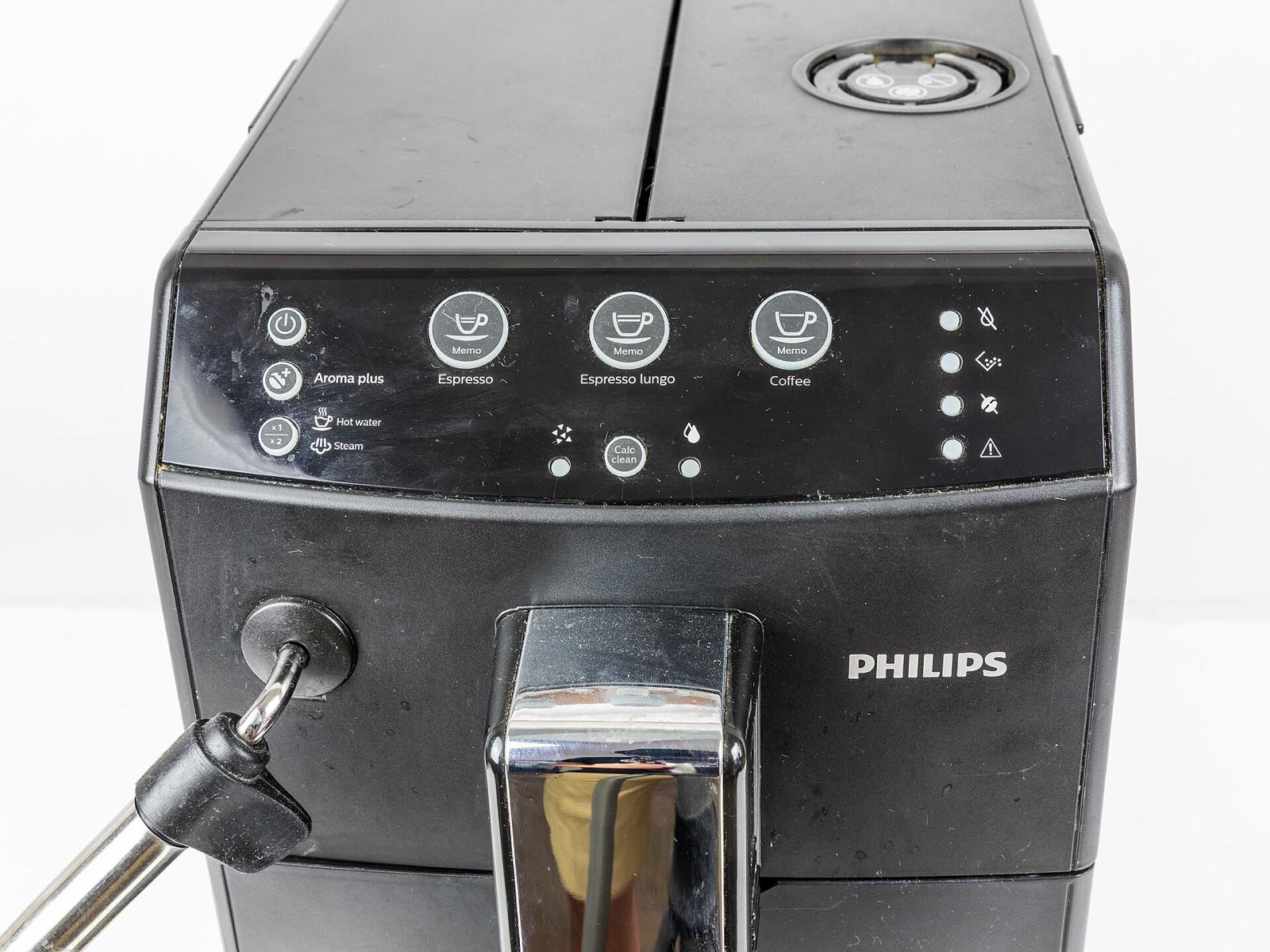
Philips 3300 Series LatteGo
Philips says its LatteGo milk system 'can be cleaned in as little as 10 seconds'. It has a 0.26 l milk container, 12 grinder settings, a 1.8 l tank and five pre-programmed drinks.
Buy it if: Households that skip cleaning anything with tubes. Skip it if: You need more than five drink presets.
- Type
- Super-automatic (bean to cup)
- Grinder
- built-in grinder, 12 grinder settings (ceramic per Amazon listing); 275 g bean container
- Milk
- LatteGo milk system (0.26 l milk container)
- Water tank
- 1,8 l
- Size (W×D×H)
- Product Length 371 mm, Width 246 mm, Height 433 mm (as published)
- Weight
- 17.6 lb
Specs: Philips US product specifications (EP3341/50, Philips product data API for the US page) (2026-11-09); Philips US product page (2026-11-09); Philips listing on Amazon (2026-11-09)
3. Two bean hoppers
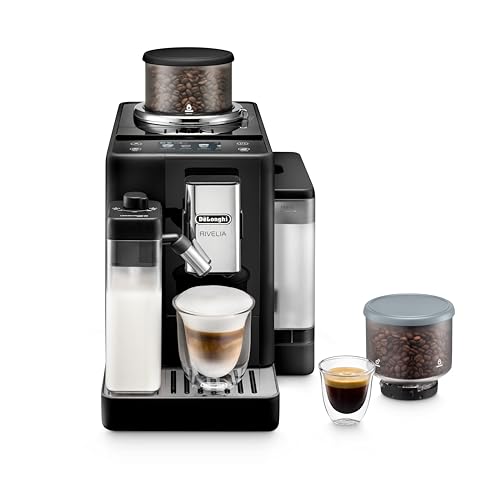
De'Longhi Rivelia
De'Longhi lists two removable 8.8 oz bean hoppers (Bean Switch) for swapping regular and decaf, 18 preset recipes, the LatteCrema Hot System and Bean Adapt guided set-up of grind, dose and temperature.
Buy it if: Homes where one person drinks decaf. Skip it if: Counter depth is tight: De'Longhi lists it at 17 in long.
- Type
- Super-automatic (bean to cup)
- Heating
- Thermoblock
- Grinder
- conical burr, 13 settings; two removable 8.8 oz bean hoppers (Bean Switch)
- Milk
- LatteCrema Hot System (automatic milk frother)
- Water tank
- 47.34 oz
- Size (W×D×H)
- 17 x 9.75 x 14.75 in (maker label: L x W x H)
- Weight
- 28 lb
Specs: De'Longhi US product page (2026-11-09); De'Longhi listing on Amazon (2026-11-09)
4. Milk pipe, 17 specialties
Jura E8 (2023, Chrome)
JURA lists the HP3 milk system with a milk pipe and glass container, 17 specialties, three brewing-temperature levels and One-Touch automatic milk system cleaning.
Buy it if: Buyers who want a long drink menu and automatic milk-pipe cleaning. Skip it if: You dislike milk tubes; a carafe system such as LatteGo has no pipe.
- Type
- Super-automatic (bean to cup)
- Heating
- Thermoblock heating system
- Grinder
- P.A.G.2 grinder, 7 programmable grind levels; bean container 9.9 oz / 280 g
- Milk
- HP3 milk system with interchangeable CX3 milk spout (milk pipe + glass milk container)
- Water tank
- 64 oz / 1.9 l
- Size (W×D×H)
- 11 in x 13.8 in x 17.6 in (W x H x D); 28 x 35.1 x 44.6 cm
- Weight
- 22.1 lb
Specs: JURA US product page (Specifications tab) (2026-11-09); Jura listing on Amazon (2026-11-09)
5. Simplest, manual milk
Philips 2200 Series (classic milk frother)
Philips lists a ceramic grinder with 12 settings, a 1.8 l tank and a Classic Milk Frother wand that you use by hand. Espresso, coffee and hot water are the only presets.
Buy it if: Mostly black coffee, with the odd hand-frothed latte. Skip it if: You want milk drinks from one button.
- Type
- Super-automatic (bean to cup)
- Grinder
- ceramic grinder, 12 grinder settings; 275 g bean capacity
- Milk
- Classic Milk Frother
- Water tank
- 1.8 l
- Size (W×D×H)
- 246x371x433 mm (Product Length 433 mm, Width 246 mm, Height 371 mm)
- Weight
- 17.6 lb
Specs: Philips US product specifications (EP2220/14, Philips product data API for the US page) (2026-11-09); Philips US product page (2026-11-09); Philips listing on Amazon (2026-11-09)
6. Straight espresso and coffee only
Jura E4
JURA's E4 has no milk system in its specifications. It makes five specialties, has a Professional Aroma Grinder, a 1.9 l tank and a 5 to 16 g variable brewing unit.
Buy it if: Black-coffee drinkers who want the machine to do everything. Skip it if: Anyone in the house drinks milk drinks.
- Type
- Super-automatic (bean to cup)
- Heating
- Thermoblock heating system
- Grinder
- Professional Aroma Grinder (P.A.G.); bean container 10 oz / 280 g; variable brewing unit 5-16 g
- Milk
- none
- Water tank
- 64 oz / 1.9 l
- Size (W×D×H)
- 11 in x 13.8 in x 17.6 in (W x H x D); 28 x 34.6 x 44.4 cm
- Weight
- 22 lb
Specs: JURA US product page (Specifications tab) (2026-11-09); Jura listing on Amazon (2026-11-09)




Product prices and availability are accurate as of 2026-11-13 and are subject to change. Amazon prices are for the colour linked. Specs are the makers' published figures; we don't test machines.
Every machine, spec by spec
Filter, then tick up to four for a side-by-side view. A dash means the maker doesn't publish that figure.
| Compare | Machine | Price | Heating | PID | Grinder | Portafilter | Width | Heat-up |
|---|---|---|---|---|---|---|---|---|
| Philips 2200 Series (classic milk frother) | $369.99 | — | — | Yes | — | 9.7 in | — | |
| Philips 3300 Series LatteGo | $544.36 | — | — | Yes | — | 9.7 in | — | |
| De'Longhi Magnifica Evo (LatteCrema) | $549.95 | Flash heater | — | Yes | — | — | — | |
| De'Longhi Magnifica Start | $665.99 | Flash heater | — | Yes | — | — | — | |
| Philips 5500 Series LatteGo | $834.99 | — | — | Yes | — | 9.7 in | Ready-to-brew in 3 seconds with QuickStart | |
| Ninja AutoBarista | $949.99 | — | — | Yes | — | 10.68 in | — | |
| De'Longhi Rivelia | $999.95 | Flash heater | — | Yes | — | 9.75 in | — | |
| Jura E4 | $1399 | Flash heater | — | Yes | — | 11 in | — | |
| De'Longhi Eletta Explore | $1499.95 | — | — | Yes | — | 10.25 in | — | |
| Jura E8 (2023, Chrome) | — | Flash heater | — | Yes | — | 11 in | — |
10 of 45 machines shown, lowest price first. Prices: Amazon as of 2026-11-13, or the maker's list price where the machine isn't on Amazon.
Specs are each maker's published figures (source linked per machine). Amazon prices as of 2026-11-13; prices change. We earn from qualifying purchases; it never affects matching or order, which is lowest price first.
What a super-automatic does, and what it leaves to you
A super-automatic grinds the beans, doses and tamps them inside a sealed brew unit, pumps hot water through, and on most models froths milk into the same cup. There is no portafilter to lock in. What is left to you is filling the beans, water and milk, emptying the grounds container and drip tray, and cleaning.
You still have settings, but they are menu steps. Grind is set in fixed positions (12 on the Philips machines, 13 on De'Longhi's), strength and volume are chosen per drink, and some models add brew temperature levels. JURA lists three on the E8. That is real control, just coarser and less direct than on a semi-automatic, where grind, dose, tamp and shot time are all yours.
Day to day, the jobs that remain are small but regular. Beans go in a hopper on top (JURA lists 280 g on the E4 and E8, Philips 275 g on its 2200 and 5500), water goes in a 1.4 to 1.9 litre tank, and used pucks drop into an internal container you empty. Carafe models add a milk container to fill and put back in the fridge. None of that needs skill, which is the whole point, but it does need doing, and a machine left with milk in its carafe or pipe needs its cleaning cycle run.
The milk-system table
Milk is where super-automatics differ most. Carafe systems (De'Longhi's LatteCrema, Philips's LatteGo) draw milk from a container that clips on and goes back in the fridge. JURA's HP3 draws milk up a pipe from a container. Philips's Classic Milk Frother is a wand you operate by hand, so a 2200 makes black drinks automatically and milk drinks semi-manually.
| Machine | Milk system (maker's name) | Automatic milk? | Grind steps | Tank | Drink presets | Pump rating |
|---|---|---|---|---|---|---|
| De'Longhi Magnifica Evo | LatteCrema System, carafe | Yes | 13 | 1.8 L | 7 | 15 bar |
| De'Longhi Magnifica Start | LatteCrema Hot, carafe | Yes | 13 | 1.8 L | 5 | 15 bar |
| De'Longhi Rivelia | LatteCrema Hot System | Yes | 13 (two hoppers) | 1.4 L | 18 | 19 bar |
| De'Longhi Eletta Explore | LatteCrema, hot and cold foam | Yes | 13 | 1.8 L | 50+ | 19 bar |
| Philips 2200 | Classic Milk Frother (manual wand) | No | 12 | 1.8 l | 3 (espresso, coffee, hot water) | 15 bar |
| Philips 3300 LatteGo | LatteGo, 0.26 l container | Yes | 12 | 1.8 l | 5 | 15 bar |
| Philips 5500 LatteGo | LatteGo, 8.79 oz carafe | Yes | 12 | 1.8 l (60.87 oz) | 20 per Amazon listing | 15 bar |
| JURA E4 | None | No milk | Not stated as a count | 1.9 l | 5 | 15 bar |
| JURA E8 | HP3 milk system, CX3 spout, milk pipe | Yes | 7 levels | 1.9 l | 17 | 15 bar |
| Ninja AutoBarista | Automatic frothing, hot or iced | Yes | 50 (Grind iQ) | Not published | 10 | Not published |
Super-automatic vs semi-automatic: what you give up
The real comparison is not with a cheaper super-automatic but with a semi-automatic at the same price, such as a Breville Barista Express or a Bambino Plus with a grinder. Here is what moves to the machine, and what you lose with it.
- Grind resolution. A separate espresso grinder or a Barista Express offers finer adjustment than 12 or 13 fixed steps. Baratza notes that 'small changes in grind size can transform a cup from sour to balanced'.
- Dose and tamp. Inside a brew unit these are set by the machine; JURA's E4 lists a 5 to 16 g variable brewing unit, which you choose by strength, not by weighing.
- Basket choice. There is no single wall or pressurised basket to choose; Breville's advice on baskets for fresh versus pre-ground coffee does not apply.
- Shot timing. The machine decides when the shot ends. You set a volume, not a time.
- One body for everything. A super-automatic puts the grinder, brew unit and milk system in one machine, so a fault in one part takes the whole machine out of use.
- Speed and consistency for others. In return, anyone can make the same drink without training, which is what the type is for.
Cleaning claims, read carefully
Every super-automatic needs regular cleaning of the brew group area, the milk path and the drip tray, and each maker sells its system as the easy one. These are their claims, quoted, not our measurements.
Philips says the LatteGo 'can be cleaned in as little as 10 seconds', and that AquaClean filters allow 'up to 5,000 cups without descaling' when you change the filter when prompted. De'Longhi says the Magnifica Start's LatteCrema Hot has 'one touch automatic cleaning' and removable, dishwasher-safe components. JURA lists 'One-Touch milk system cleaning (automatic)' on the E8. Ninja lists 'auto-rinse and self-drying interior fan' on the AutoBarista.
Two practical points follow. A carafe goes in the fridge and the dishwasher; a milk pipe has to be rinsed through after use, which the automatic cleaning cycles exist to do. And descaling runs off each machine's own prompt and your water. Breville's manuals, for its machines, tie descaling to the indicator rather than a calendar, and that is the safest way to read any maker's schedule.
Will it fit? Check depth and height
Super-automatics are deep. The bean hopper sits on top, the water tank usually at the side or back, and the brew unit in the middle. Of the models whose makers give dimensions in a clear order, all are about 17 inches or more deep, against 12.5 inches for a Breville Bambino Plus.
Height matters too, because you fill beans from above. The figures in the chart are the machine alone; leave room to open the hopper lid under a wall cabinet.
Does 19 bar beat 15 bar?
No, and this matters because two De'Longhi models list 19 bar and the rest 15. Both numbers are maximum pump ratings. The Istituto Nazionale Espresso Italiano sets espresso at 9 bar plus or minus 1, and the heritage SCAA definition at 9 to 10 atmospheres. A higher rating does not mean the coffee is extracted at that pressure, and it is not a reason to pick one super-automatic over another.
What does change the drink is grind, dose and temperature, which on a super-automatic you reach through the menu. JURA's E8 lists three temperature levels; De'Longhi's Rivelia offers Bean Adapt guided set-up of grind, dose and temperature; Philips's 2200 lists three aroma strength and three temperature settings.
Warm-up and noise: only some makers say
Few super-automatic makers publish a warm-up time. Philips's Amazon listing for the 5500 says it is 'Ready-to-brew in 3 seconds with QuickStart'. De'Longhi and JURA give no figure on the spec pages read for this guide.
Noise claims are rarer still and are always the maker's own test. Philips says SilentBrew makes the 3300 '40% quieter' (Philips consumer test, Germany 2023) and that the 5500 is 'certified by Quiet Mark'. Treat these as reasons to look, not as measured facts.
Match the machine to the household
If two people drink lattes every morning and nobody wants to learn, a carafe model (Magnifica Evo or 3300 LatteGo) covers it. If one person drinks decaf, the Rivelia's two hoppers avoid emptying beans. If the house drinks many different things, from cortados to iced lattes, the menu length on the Eletta Explore or the Philips 5500 earns its price. If nobody takes milk, the JURA E4 spends nothing on a milk system you would not use.
Ninja's AutoBarista is the outlier. Ninja's listing gives it a grinder that picks from 50 settings on its own (Grind iQ), 10 hot and iced drinks, automatic frothing of 'dairy or plant-based' milk, and an auto-rinse with a 'self-drying interior fan'. Ninja publishes no pump rating, tank size or wattage for it, so it is harder to compare on paper than the De'Longhi, Philips and JURA models, which publish all three. If iced drinks matter most, it and the Eletta Explore are the two whose makers lead with them.
If you are on the fence, look at the semi-automatic side as well. The Bambino Plus textures milk automatically but needs a grinder and a tamp; the Barista Express has a built-in grinder and a manual wand. Our types of espresso machines hub sets both against super-automatics step by step, and the comparison tool on this page filters the whole catalogue by type and price.
Questions people ask
- Is a super automatic espresso machine worth it?
- If convenience matters more than control, yes: anyone in the house gets the same drink from one button. If you want to adjust grind, dose, tamp and shot time, a semi-automatic with a grinder gives more control for similar money.
- Do super-automatic machines make real espresso?
- They grind and push pressurised water through coffee, which is how espresso is made. INEI and the heritage SCAA definition set 9 to 10 bar; the 15 or 19 bar on the box is a pump maximum, not the brew pressure.
- Which super-automatic is easiest to clean?
- By the makers' own claims, Philips's LatteGo (cleaned 'in as little as 10 seconds') and De'Longhi's LatteCrema Hot (one-touch automatic cleaning, dishwasher-safe parts) are pitched as easiest. These are claims, not our measurements.
- Can you use pre-ground coffee in a super-automatic?
- The spec pages read for this guide do not state it for most models, so check the manual for the exact model before you rely on pre-ground coffee.
- How deep are super-automatic espresso machines?
- Of the models whose makers give clear dimensions, all are about 17 inches deep or more, from 17 in (Rivelia, Philips 2200) to 17.81 in (Ninja AutoBarista).
- What is the difference between LatteGo and LatteCrema?
- Both are carafe-style automatic milk systems. LatteGo is Philips's (0.26 l container on the 3300); LatteCrema is De'Longhi's, with a carafe on the Magnifica models and hot and cold foam on the Eletta Explore.
Sources & further reading
- De'Longhi Magnifica Evo US product page (2026-11-09)
- De'Longhi Magnifica Start US product page (2026-11-09)
- De'Longhi Rivelia US product page (2026-11-09)
- De'Longhi Eletta Explore US product page (2026-11-09)
- Philips 2200 Series US specifications (2026-11-09)
- Philips 3300 Series LatteGo US product page (2026-11-09)
- Philips 5500 Series US product page (2026-11-09)
- Philips 5500 Series listing on Amazon: QuickStart, presets (2026-11-09)
- JURA E4 US product page, Specifications tab (2026-11-09)
- JURA E8 US product page, Specifications tab (2026-11-09)
- Ninja AutoBarista listing on Amazon (2026-11-09)
- Breville Bambino Plus listing on Amazon: dimensions (2026-11-09)
- INEI, A Brief Guide to the Italian Certified Espresso, archive copy (2026-11-09)
- SCA 25 Magazine, Defining the Ever-Changing Espresso (2026-11-09)
- Baratza, Switching Grind Settings with Confidence (2026-11-09)
- Breville Barista Express BES875 instruction book: baskets, descaling (2026-11-09)
Read next
- Types of Espresso Machines
Types of espresso machines sorted two ways: who grinds, tamps and stops the shot, and how the water is heated. A step-by-step table and 45 machines counted.
- Espresso Machines With a Grinder
Espresso machine with grinder or separate grinder? Compare cost, counter width, grind settings and repair risk, with built-in models from $300 to $2,000.
- Espresso Machines for Lattes
Best espresso machine for lattes by milk system: manual wand, automatic wand, carafe or whisk, plus boiler type for back-to-back drinks. Maker specs only.
- Best Espresso Machines Under $1,000
Best espresso machine under 1000 dollars, picked from makers' spec sheets: built-in grinder or not, PID, 58 mm baskets, milk automation and live prices.
- Espresso Machine Comparison
Espresso machine comparison tool and chart: filter 45 machines by type, heater, PID, grinder, portafilter and milk, and learn what each spec column means.
- Is Home Espresso Worth It?
Is home espresso worth it? Enter your café price, drinks per week and setup cost to see your cost per drink and break-even week. Worked example shown in full.
Part of Types of Espresso Machines. Back to the EspressoGoods home page.

EspressoGoods editors · Editorial team
EspressoGoods' catalogue and guides are compiled by the site's editorial team from espresso machine and grinder makers' own product pages, spec sheets and manuals, plus standards bodies such as the Istituto Nazionale Espresso Italiano. We do not test machines or taste shots, and we never claim to: every spec on the site links to the page it came from.
About this site · How pages are checked · Last updated November 8, 2026
As an Amazon Associate, EspressoGoods earns from qualifying purchases. It costs you nothing extra and never decides which machines we list.
EspressoGoods is an independent site. It is not affiliated with Breville, De'Longhi, Gaggia, Rancilio, Philips, Ninja or any other maker. Brand names and trademarks belong to their owners. Specs are the makers' published figures; check the maker's page before you buy.