Guide
Best Espresso Machine Under 200 Dollars: Myths, Pros and Cons
By EspressoGoods editors · Updated 2026-11-08 · How we research
We may earn a commission when you buy through links on this page.
Short answer
Shop for temperature control and baskets, not the bar number. The CASABREWS CM5418 and 3700 Essential are the cheapest with maker-stated PID; the De'Longhi Stilosa is the cheapest major-brand boiler machine. Start with pressurised baskets. No outlet? The Flair Classic manual press.
Shopping for the best espresso machine under 200 dollars means getting past two myths that sell most machines at this price. The first is that a bigger pump number makes a better machine: boxes shout 15 bar, 19 bar and 20 bar. The second is that the double-walled 'pressurised' basket in the box is a cheap shortcut you should throw away. Neither is true, and believing either one leads to the wrong purchase.
We clear both up first, with the standards and makers' manuals behind them. Then come six machines under $200, each with the specs its maker publishes and plain pros and cons. Live prices are on the cards; specs were read from makers' pages on 9 November 2026. We compile published specs; we did not run the machines ourselves.
Six picks under $200
1. Best under $200 overall
CASABREWS CM5418
CASABREWS lists PID temperature control, a thermoblock single boiler, a built-in pressure gauge and a 51 mm portafilter with one- and two-cup filters. The gauge shows you what the machine is doing during a shot.
Buy it if: A first machine where you want to see pressure and keep temperature controlled. Skip it if: You need exact dimensions now: CASABREWS lists them without saying which figure is width.
- Type
- Semi-automatic
- Heating
- Thermoblock Single Boiler
- PID
- Yes
- Portafilter
- 51 mm
- Milk
- steam wand
- Water tank
- 34 oz (up to 10 cups)
- Size (W×D×H)
- 5.9'' x 11.97'' x 12.28'' (order not stated)
- Weight
- 8.6 lb
Specs: CASABREWS US product page (2026-11-09); CASABREWS listing on Amazon (2026-11-09)
2. Cheapest with PID
CASABREWS 3700 Essential
The 3700 Essential pairs PID with a thermoblock and low-pressure pre-infusion, per CASABREWS, and has a 43.9 oz (1.3 L) tank. It shares the 51 mm portafilter size of the CM5418.
Buy it if: The lowest price that still comes with temperature control the maker documents. Skip it if: You want a pressure gauge; CASABREWS lists one on the CM5418, not the 3700.
- Type
- Semi-automatic
- Heating
- Thermoblock Heating System
- PID
- Yes
- Portafilter
- 51 mm
- Milk
- steam wand
- Water tank
- 43.9 oz / 1.3 L
- Size (W×D×H)
- 12.99" × 6.49" × 12.13" (order not stated)
- Weight
- 8.14 lb
Specs: CASABREWS US product page (2026-11-09); CASABREWS listing on Amazon (2026-11-09)
3. Cheapest boiler machine
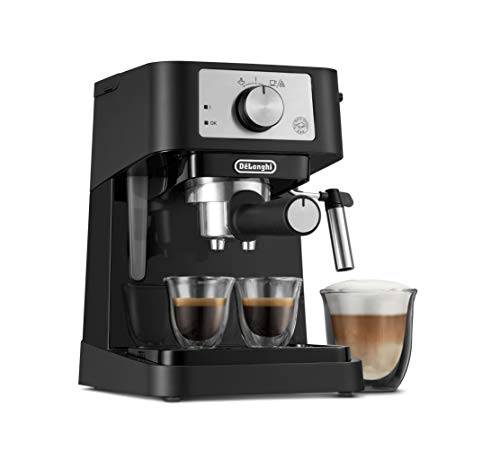
De'Longhi Stilosa
De'Longhi uses a stainless steel boiler with a 15 bar pump, a manual steam wand and a 33.81 oz tank, and gives a weight of 10.99 lb. It ships with two filters for single or double espresso.
Buy it if: Buyers who want a long-established maker and a simple machine. Skip it if: You want PID or a published portafilter size; De'Longhi states neither.
- Type
- Semi-automatic
- Heating
- Boiler (stainless steel boiler)
- Milk
- manual steam wand
- Water tank
- 33.81 oz
- Size (W×D×H)
- 13.5 x 8.07 x 11.22 in (maker label: L x W x H)
- Weight
- 10.99 lb
Specs: De'Longhi US product page (2026-11-09); De'Longhi listing on Amazon (2026-11-09)
4. For pre-ground coffee only
De'Longhi Classic (sold on Amazon as Classic Signature)
De'Longhi's Classic has a thermoblock, a visual pressure gauge, single and double presets and a dual-mode steam wand. Its three filters are all double wall, so it is built for pre-ground coffee.
Buy it if: Someone who will never buy a grinder and wants pre-ground coffee to work. Skip it if: You plan to grind fresh and dial in; there is no single-wall basket in the box.
- Type
- Semi-automatic
- Heating
- Thermoblock
- Milk
- adjustable steam wand (dual mode frother)
- Water tank
- 1943.63 (maker data field labelled oz; unit unclear)
- Size (W×D×H)
- 11.2 x 9 x 12 in (maker label: L x W x H)
- Weight
- 11.55 lb
Specs: De'Longhi US product page (2026-11-09); De'Longhi listing on Amazon (2026-11-09)
5. Fastest start (maker's claim)
CASABREWS 5418 PRO
CASABREWS says Flashheat heats the 5418 PRO in 5 seconds and switches to steam in 3, and lists PID and a pressure gauge. Its 5.9 in width is the slimmest of the electric picks.
Buy it if: Tight counters and people who want a shot the moment they switch on. Skip it if: You want a published portafilter size and tank volume; CASABREWS's spec table for it was a copy of another model's, so we left those blank.
- Type
- Semi-automatic
- Heating
- Flashheat Technology (Thermoblock Heating System)
- PID
- Yes
- Milk
- steam wand
- Heat-up (maker)
- 5 seconds
- Size (W×D×H)
- 5.9 x 12.28 x 11.97 in (Amazon: width x length x height)
- Weight
- 8.38 lb
Specs: CASABREWS US product page (2026-11-09); CASABREWS listing on Amazon (2026-11-09)
6. No electricity
Flair Classic
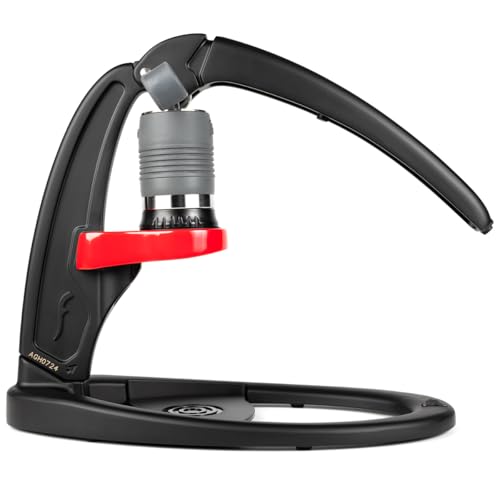
A direct lever press: Flair says it is 100% human-powered, with a gauge marked for 9 bar brewing, a 40 mm portafilter and 60 ml of water per shot from your kettle. The brewing head comes apart for cleaning.
Buy it if: Straight espresso, travel or a kitchen without counter power. Skip it if: You want milk drinks; it has no steam wand.
- Type
- Manual lever
- Heating
- No heater (manual)
- Portafilter
- 40 mm
- Milk
- none
- Water tank
- Input Water Capacity – 60ml
- Size (W×D×H)
- 12.5" L x 6.25" W x 10" H (assembled)
- Weight
- 5 lb
Specs: Flair Espresso US product page (2026-11-09); Flair listing on Amazon (2026-11-09)




Product prices and availability are accurate as of 2026-11-13 and are subject to change. Amazon prices are for the colour linked. Specs are the makers' published figures; we don't test machines.
Find the espresso machines that fit you
Answer what matters; leave the rest on “Any”. Matching uses only the makers' published specs and today's prices.
Wacaco Minipresso GR
Portable · No heater
Why it fits: $46.90 (Amazon 2026-11-13)
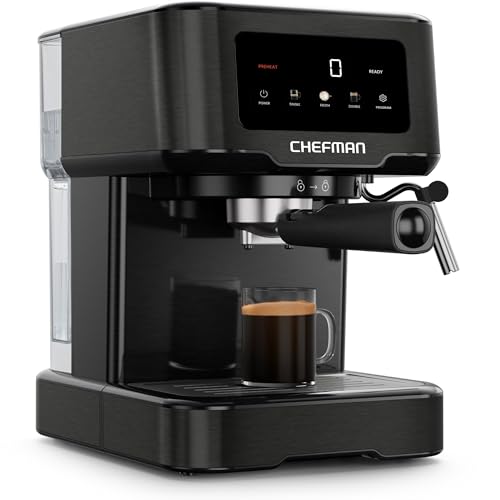
Chefman CraftBrew Espresso Machine
Semi-automatic · 8.9 in wide
Why it fits: $79.97 (Amazon 2026-11-13)
CASABREWS 3700 Essential
Semi-automatic · Flash heater · 51 mm
Why it fits: $99.99 (Amazon 2026-11-13)
De'Longhi Stilosa
Semi-automatic · Single boiler · 8.07 in wide
Why it fits: $139.95 (Amazon 2026-11-13)
CASABREWS CM5418
Semi-automatic · Flash heater · 51 mm
Why it fits: $139.99 (Amazon 2026-11-13)
De'Longhi Classic (sold on Amazon as Classic Signature)
Semi-automatic · Flash heater · 9 in wide
Why it fits: $149.95 (Amazon 2026-11-13)
Flair Classic
Manual lever · No heater · 40 mm · 6.25 in wide
Why it fits: $159 (Amazon 2026-11-13)
CASABREWS 5418 PRO
Semi-automatic · Flash heater · 5.9 in wide
Why it fits: $161 (Amazon 2026-11-13)

Near misses (one requirement short)
- CASABREWS Ultra $209.99 · missing: under $200
- Breville Bambino $299.95 · missing: under $200
- CASABREWS Marenza $299.99 · missing: under $200
- Flair 49 PRO $359 · missing: under $200
Specs are each maker's published figures (source linked per machine). Amazon prices as of 2026-11-13; prices change. We earn from qualifying purchases; it never affects matching or order, which is lowest price first.
Myth one: 20 bar beats 15 bar
The bar figure on the box is the pump's maximum rating. Espresso is extracted at about 9 bar. The Istituto Nazionale Espresso Italiano lists 9 bar ± 1 among its conditions for a certified espresso, and the heritage SCAA definition, as published by the Specialty Coffee Association, says 9 to 10 atmospheres. Even Breville, whose machines carry 15 bar pumps, writes 'the 15 bar Italian pump' in its manual and treats a gauge that does not reach 9 bar as the problem to fix.
So a 20-bar CASABREWS and a 15-bar De'Longhi are both aiming at the same 9 bar. What decides whether they get there with your coffee is the basket and the grind.
Pre-infusion is the spec worth looking for instead. CASABREWS lists low-pressure pre-infusion on the 3700 Essential and the 5418 PRO, and Breville lists it on the Bambino. It wets the coffee at low pressure before full pressure builds, which is what a maker means when it lists it as a separate stage. It is a far more useful line on a spec sheet than the pump's maximum.
- Pro of a high rating: none for the shot itself; the pump is not run at its maximum.
- Con: the label distracts from specs that matter, such as PID and basket type.
- What to compare instead: heater type, whether PID is stated, portafilter size and the baskets in the box.
Myth two: pressurised baskets are a cheat
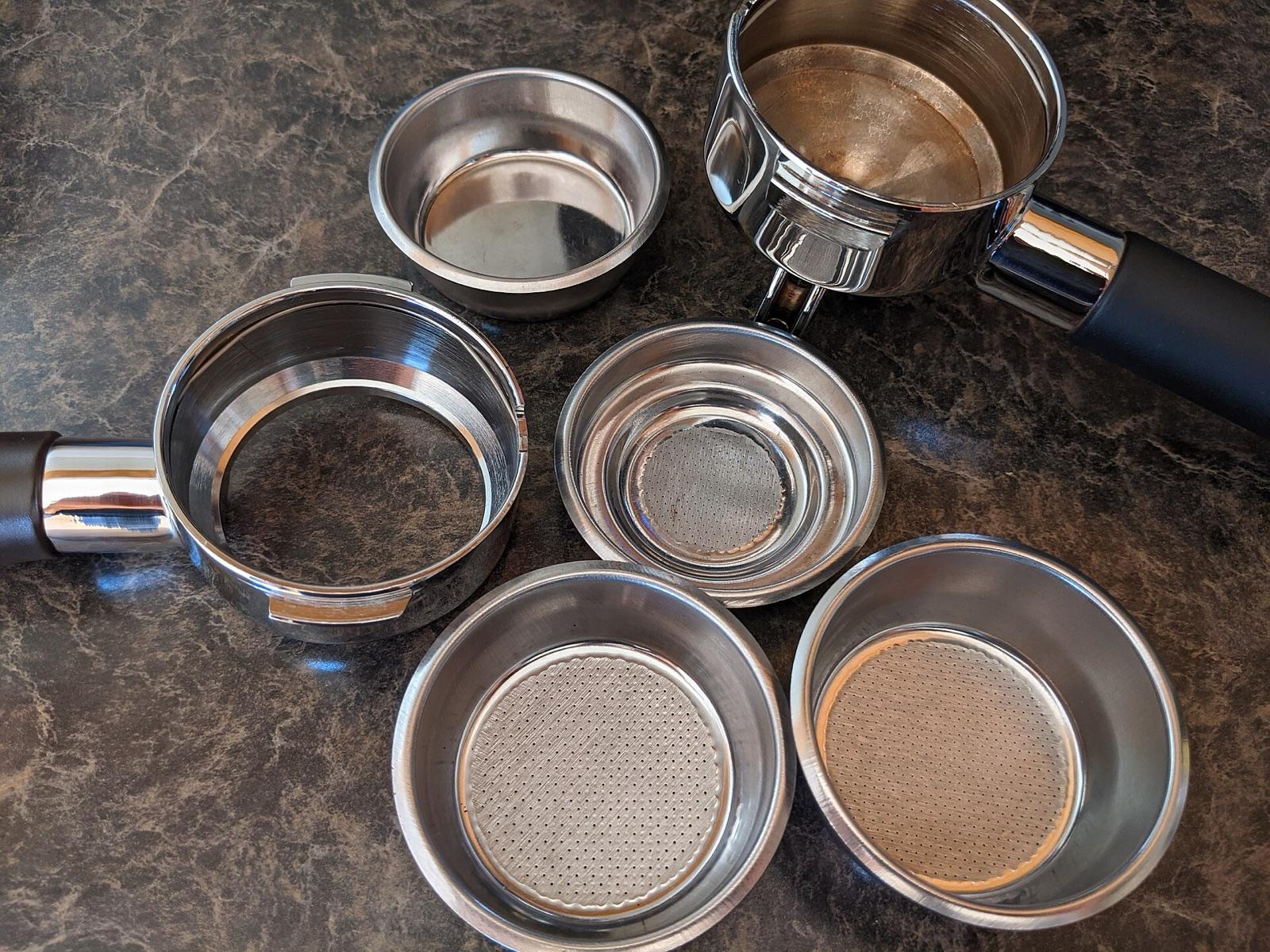
A pressurised, or dual-wall, basket has a second wall with a tiny exit hole. Breville explains what it is for: dual-wall baskets are for pre-ground coffee and 'regulate the pressure and help to optimise the extraction regardless of the grind, dose, tamp pressure or freshness'. Single-wall baskets are for freshly ground beans and let you experiment with grind, dose and tamp.
Under $200, most buyers do not own an espresso grinder, so the pressurised basket is the right tool to start with. The trap is the other way round: putting pre-ground supermarket coffee in a single-wall basket, which usually runs fast and sour because the grind is too coarse.
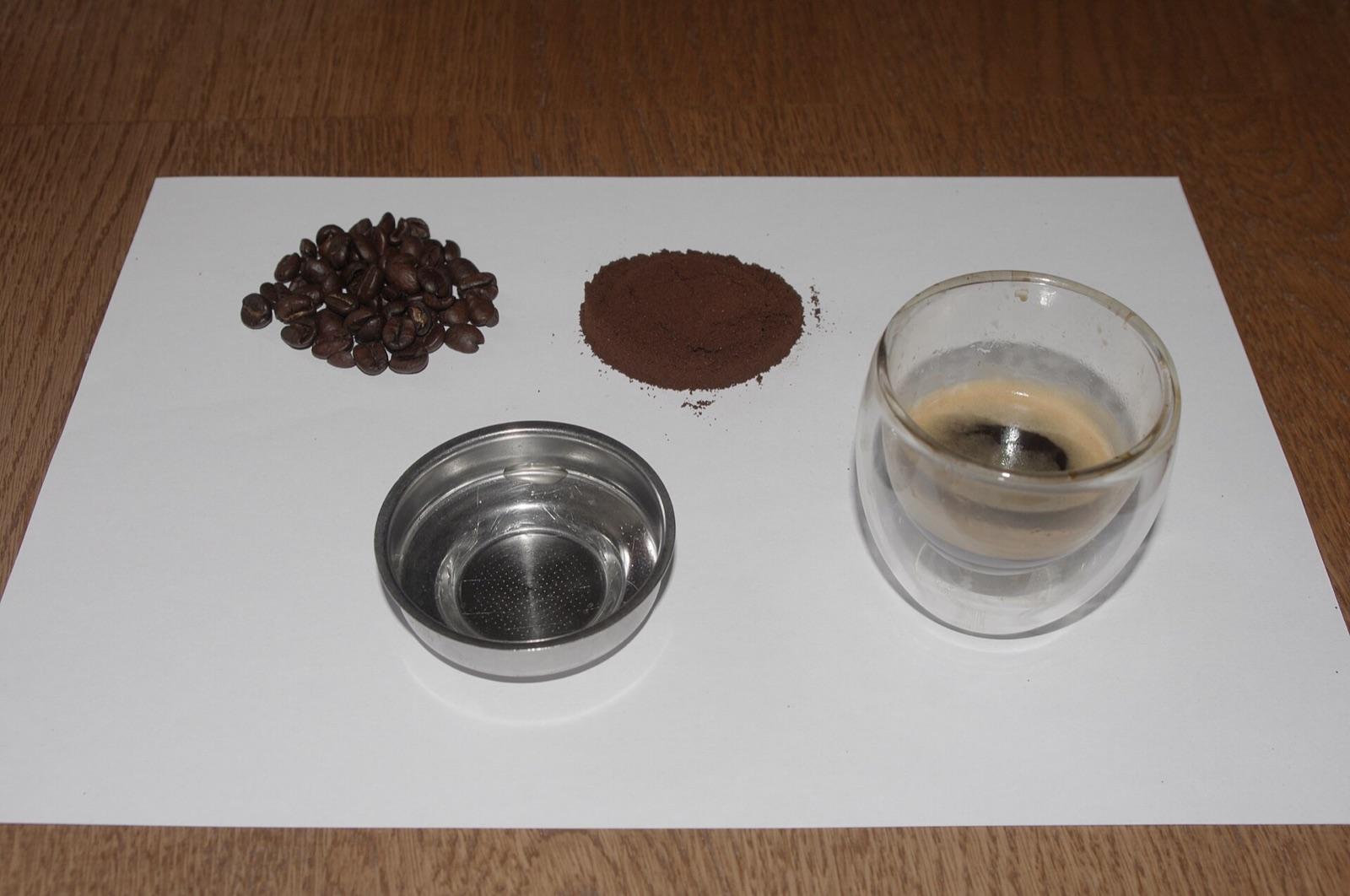
How do you tell which basket you have? Breville labels them in its manuals as single wall and dual wall. Hold one up to the light: a dual-wall basket usually shows a single small exit hole on its underside, while a single-wall basket has a grid of many fine holes across the base. If your machine shipped with both, keep the single-wall basket for the day you buy a grinder.
- Pro: works with pre-ground coffee and forgives uneven dosing and tamping.
- Pro: no grinder purchase needed on day one.
- Con: hides your changes, so you cannot dial in the shot.
- Upgrade path: buy a grinder later and switch to a single-wall basket, if your machine ships with one or accepts one.
CASABREWS or De'Longhi? Eight machines under $200 compared
Two brands fill most of our shortlist for the best espresso machine under 200 dollars. CASABREWS states PID on every model and uses a 51 mm portafilter on its cheapest two. De'Longhi uses a boiler on the Stilosa and a thermoblock on the Classic, and states neither PID nor a portafilter size. The table adds the Chefman CraftBrew and two non-electric options.
Every machine in this group is light. Makers give weights of 8.14 lb for the 3700 Essential, 8.38 lb for the 5418 PRO, 8.6 lb for the CM5418, 10.99 lb for the Stilosa and 11.55 lb for the De'Longhi Classic. Power draw is 1350 W for the CM5418, 3700 Essential, Chefman and Classic, and 1100 W for the Stilosa. None of those figures changes the shot, but they tell you all of these machines fit on an ordinary kitchen circuit and can be moved to a cupboard between uses.
- CASABREWS pros: PID stated on every model; pressure gauges on the CM5418 and 5418 PRO; large tanks for the price.
- CASABREWS cons: the 51 mm size has fewer third-party baskets and tampers than 54 mm or 58 mm; several dimensions and specs are published without clear labels.
- De'Longhi pros: a long-established maker; a boiler in the Stilosa; a gauge and presets on the Classic.
- De'Longhi cons: no PID stated, no portafilter size published, and the Classic ships with double-wall filters only.
| Machine | Heater (maker's term) | PID | Portafilter | Baskets | Pump rating | Tank |
|---|---|---|---|---|---|---|
| CASABREWS 3700 Essential | Thermoblock | Yes | 51 mm | One- and two-cup filters | 20 bar | 43.9 oz |
| CASABREWS CM5418 | Thermoblock single boiler | Yes | 51 mm | One- and two-cup filters | 20 bar | 34 oz |
| CASABREWS 5418 PRO | Flashheat (thermoblock) | Yes | Not published | Not published | 20 bar | Not published |
| Chefman CraftBrew | Not published | Not stated | Not published | Single and double | 15 bar | 1.5 L |
| De'Longhi Stilosa | Stainless steel boiler | Not stated | Not published | Two filters | 15 bar | 33.81 oz |
| De'Longhi Classic | Thermoblock | Not stated | Not published | Double wall 1 and 2 cup | 15 bar | Unclear on maker page |
| Flair Classic | None (kettle water) | Not applicable | 40 mm | Flow control and bottomless | Lever, 9 bar gauge | 60 ml |
| Wacaco Minipresso GR | None (boiling water) | Not applicable | Not published | Ground-coffee basket | Not published | Not published |
Should you skip electricity altogether?
For straight espresso, a manual press is a serious option at this price. The Flair Classic puts the pressure in your arm: you pour kettle water into the cylinder and pull the lever while watching a gauge marked for 9 bar. Flair lists a 40 mm portafilter, 60 ml of water per shot and a detachable brewing head.
The Wacaco Minipresso GR is smaller still. Wacaco's listing says it needs no battery or power: you add ground coffee and boiling water and pump to build pressure. Wacaco does not publish the pressure it reaches, so treat it as a travel tool, not a home machine.
- Pro: no counter power and no machine warm-up; only the water is heated.
- Pro: the Flair's gauge lets you see and control pressure directly.
- Con: no steam wand on either, so no milk drinks without a separate frother.
- Con: both still need fine, fresh coffee for a good shot, so the grinder question does not go away.
What $200 cannot buy
It helps to be clear about the limits, so you know what you are trading. These are the gaps in the sub-$200 group, from the specs makers publish:
You can, though, build a complete fresh-ground setup for not much more than $200. A CASABREWS 3700 Essential at around $110 with the SHARDOR grinder at around $70 comes to roughly $180, and a CM5418 with the same grinder to about $210. SHARDOR's listing gives 51 settings from the finest for espresso and a portafilter cradle, though it does not publish the cradle's size, so check it fits the 51 mm portafilter.
- A grinder. Espresso-capable grinders in our catalogue start around $70 (SHARDOR) and are mostly near $200, so a real dial-in setup costs more than $200 in total.
- The common portafilter sizes. None of the electric machines here publishes a 54 mm or 58 mm portafilter; the CASABREWS models use 51 mm.
- Brewing and steaming at once. None of the electric machines here lists a second boiler or heater, so you pull the shot, then switch to steam.
- Hands-free milk. The cheapest automatic wand in our catalogue is on the Breville Bambino Plus, around $500.
- Complete spec sheets. Chefman publishes no heater type; De'Longhi's Classic tank figure is unclear; CASABREWS lists dimensions without axis labels on some models. Buy where returns are easy.
Filter the list to your kitchen
The finder is preset to a $200 budget, so every result is a candidate for the best espresso machine under 200 dollars. Tell it whether you drink milk drinks and how wide your counter space is, and it returns the machines that fit, with today's prices. If nothing suits, set the budget to $500 and look at the split between a machine and a grinder on our under-$500 page.
Before you order, run through four checks. Does the maker state PID or a temperature setting? Which baskets are in the box, single wall, dual wall or both? Is the portafilter size published, so you can buy a tamper that fits? And do the published dimensions say which figure is width? A machine that fails all four is not necessarily bad, but you will be buying it with less information than the alternatives give you.
Questions people ask
- Can you get a real espresso machine for under $200?
- Yes, a pump machine that can reach 9 bar. Whether it makes espresso by the INEI definition depends on fresh, finely ground coffee and a single-wall basket. With pre-ground coffee, use the pressurised basket and expect espresso-style coffee.
- Is the De'Longhi Stilosa good for beginners?
- It is a simple boiler machine with a 15 bar pump and a manual steam wand from a major maker. De'Longhi does not state PID or a portafilter size. Our De'Longhi Stilosa page covers it in detail.
- Is a 20 bar espresso machine better than 15 bar?
- No. Both figures are pump maximums. INEI and the heritage SCAA definition put extraction at about 9 bar.
- Do I need a grinder with a $150 espresso machine?
- Not at first. Use the pressurised basket with pre-ground coffee. To dial in with a single-wall basket you need a grinder that can go espresso-fine, which costs about $70 to $200.
- Which cheap espresso machines have PID?
- In our catalogue, the CASABREWS 3700 Essential, CM5418 and 5418 PRO list PID under $200. De'Longhi and Chefman do not state it for their sub-$200 models.
- Can a cheap espresso machine steam milk?
- All the electric machines here have a steam wand. You texture the milk yourself, and you wait for the heater to switch from brew to steam temperature.
- What size portafilter do cheap espresso machines use?
- CASABREWS lists 51 mm for the 3700 Essential and CM5418. De'Longhi and Chefman do not publish a size. The Flair Classic uses 40 mm.
- Is a moka pot a cheaper way to make espresso?
- A moka pot makes strong stovetop coffee, not espresso. Bialetti says it brews at about 1.5 bar, against at least 9 bar for espresso machines.
Sources & further reading
- INEI, A Brief Guide to the Italian Certified Espresso (archive copy, read 2026-11-09)
- SCA 25 Magazine, Defining the Ever-Changing Espresso (2026-11-09)
- Breville Barista Express BES875 instruction book (baskets, pump rating; 2026-11-09)
- Breville Dual Boiler BES920 instruction book (9 bar fault; 2026-11-09)
- Bialetti, How the Moka works (2026-11-09)
- CASABREWS CM5418 product page (2026-11-09)
- CASABREWS 3700 Essential product page (2026-11-09)
- CASABREWS 5418 PRO product page (2026-11-09)
- De'Longhi Stilosa EC260BK US product page (2026-11-09)
- De'Longhi Classic EM450M US product page (2026-11-09)
- Chefman CraftBrew, Chefman listing on Amazon (2026-11-09)
- Flair Classic product page (2026-11-09)
- Wacaco Minipresso GR, Wacaco listing on Amazon (2026-11-09)
- r/espresso thread: Best machine under $200? (owner opinions)
Read next
- Budget Espresso Machines
Best budget espresso machine picks from about $110 to $500, sorted by what each price step adds: PID, basket type, portafilter size and the grinder you need.
- Espresso Machines Under $500
Best espresso machine under 500 dollars, with the grinder counted: five ways to split $500, spec tables from makers' pages, and the 54 vs 58 mm question.
- De'Longhi Stilosa
DeLonghi Stilosa specs from De'Longhi's own page: single boiler, 15 bar pump, manual wand, no PID or size listed. What it can't do, and the rivals to weigh.
- Best Espresso Machine for Beginners
Best espresso machine for beginners, chosen in six steps: forgiving baskets, a grinder budget, push-button or manual, and makers' specs with live prices.
Part of Budget Espresso Machines. Back to the EspressoGoods home page.

EspressoGoods editors · Editorial team
EspressoGoods' catalogue and guides are compiled by the site's editorial team from espresso machine and grinder makers' own product pages, spec sheets and manuals, plus standards bodies such as the Istituto Nazionale Espresso Italiano. We do not test machines or taste shots, and we never claim to: every spec on the site links to the page it came from.
About this site · How pages are checked · Last updated November 8, 2026
As an Amazon Associate, EspressoGoods earns from qualifying purchases. It costs you nothing extra and never decides which machines we list.
EspressoGoods is an independent site. It is not affiliated with Breville, De'Longhi, Gaggia, Rancilio, Philips, Ninja or any other maker. Brand names and trademarks belong to their owners. Specs are the makers' published figures; check the maker's page before you buy.