Section
Best Budget Espresso Machine: What Each Price Step Buys
By EspressoGoods editors · Updated 2026-11-08 · How we research
We may earn a commission when you buy through links on this page.
Short answer
The Breville Bambino is the best budget espresso machine for most buyers: Breville lists PID temperature control, a 54 mm portafilter with single- and dual-wall baskets, and a ThermoJet heater ready in 3 seconds. Around $200, the CASABREWS Ultra adds a 58 mm portafilter. Below that, expect pressurised baskets and pre-ground coffee, and keep about $100 to $200 aside for a grinder.
The best budget espresso machine depends on where your budget stops, because each step of about $100 buys something specific. Around $110 you get a thermoblock heater and pressurised baskets that forgive pre-ground coffee. Near $150, a boiler machine from a major maker. Around $200 a 58 mm portafilter and selectable brew temperatures. Near $300 Breville's PID-controlled Bambino. Up to $500 a built-in grinder or hands-free milk.
What the money does not change is the target: both espresso standards we use put extraction at about 9 bar of pressure for around 25 seconds. Every machine below can be dialled toward that. The real difference is how much the machine helps you get there, and whether you still have money left for a grinder that can go fine enough. Prices on the cards update daily; specs come from each maker's page.
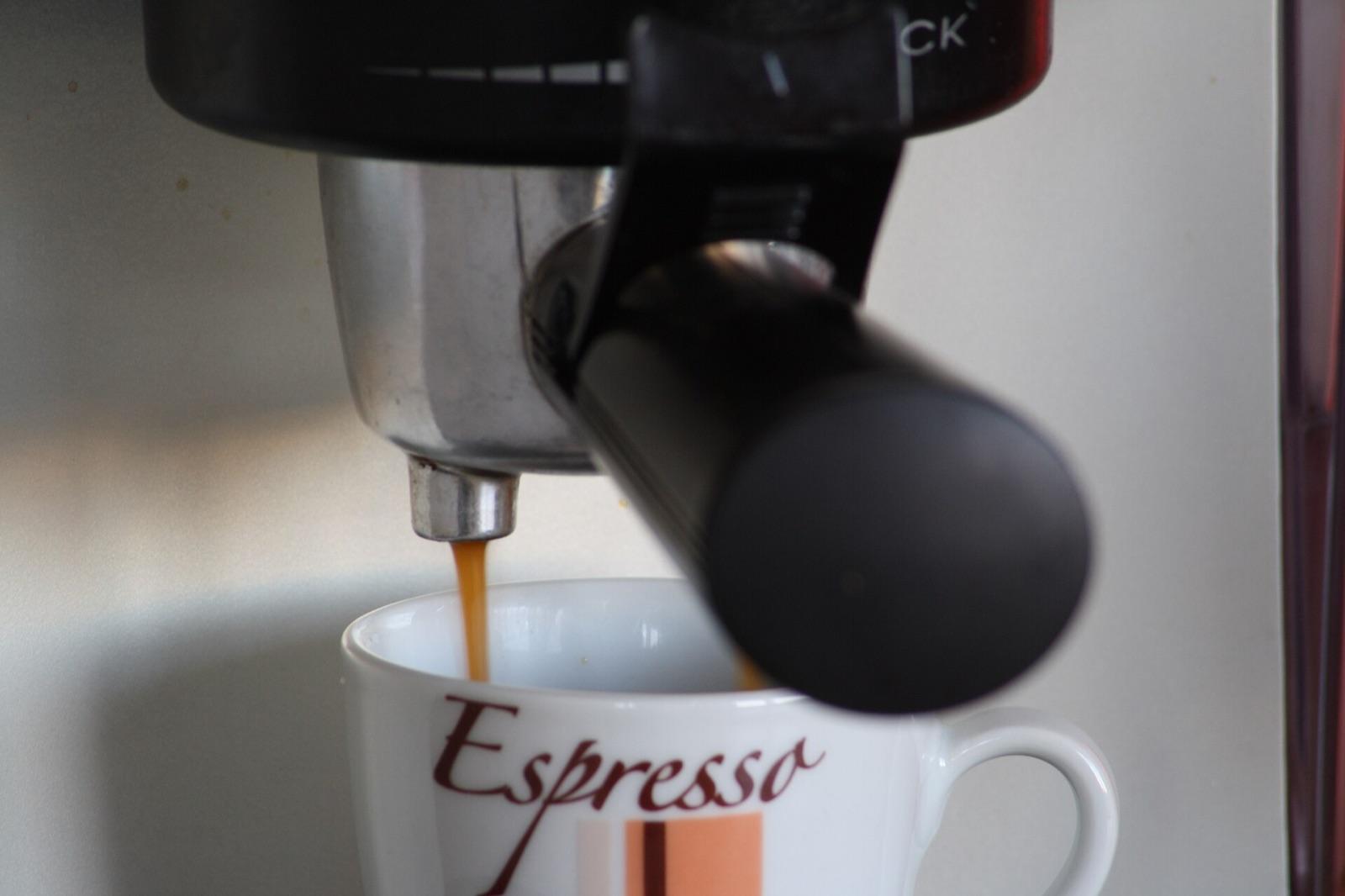
Budget picks, cheapest to dearest
1. Lowest price with PID
CASABREWS 3700 Essential
CASABREWS lists PID temperature control, a thermoblock heater, a 51 mm portafilter and a 43.9 oz (1.3 L) tank, with low-pressure pre-infusion before the shot. It is the cheapest machine in our catalogue whose maker states PID.
Buy it if: A first machine under about $120 for someone who will use pre-ground coffee at first. Skip it if: You want to swap in standard 54 mm or 58 mm accessories later; 51 mm is a smaller size with fewer options.
- Type
- Semi-automatic
- Heating
- Thermoblock Heating System
- PID
- Yes
- Portafilter
- 51 mm
- Milk
- steam wand
- Water tank
- 43.9 oz / 1.3 L
- Size (W×D×H)
- 12.99" × 6.49" × 12.13" (order not stated)
- Weight
- 8.14 lb
Specs: CASABREWS US product page (2026-11-09); CASABREWS listing on Amazon (2026-11-09)
2. Cheapest from a major maker
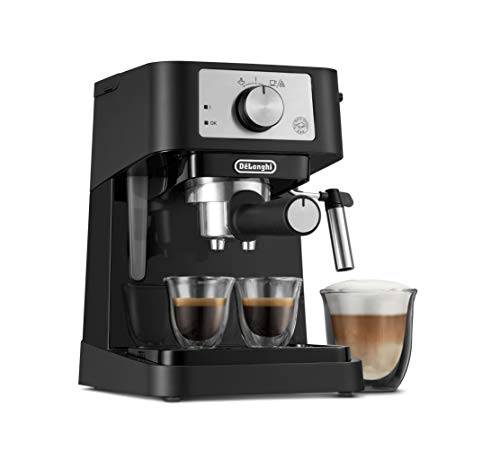
De'Longhi Stilosa
De'Longhi's Stilosa uses a stainless steel boiler, a 15 bar pump and a manual steam wand, with a 33.81 oz tank and a 1100 W heater. De'Longhi does not state PID on its US page.
Buy it if: Occasional milk drinks on the smallest budget, from a maker with a long US service history. Skip it if: You want temperature control the maker documents, or a portafilter size it publishes (De'Longhi does not list one).
- Type
- Semi-automatic
- Heating
- Boiler (stainless steel boiler)
- Milk
- manual steam wand
- Water tank
- 33.81 oz
- Size (W×D×H)
- 13.5 x 8.07 x 11.22 in (maker label: L x W x H)
- Weight
- 10.99 lb
Specs: De'Longhi US product page (2026-11-09); De'Longhi listing on Amazon (2026-11-09)
3. Best around $200
CASABREWS Ultra
The Ultra brings a 58 mm portafilter, PID, four selectable brew temperatures (194, 198, 201 and 205 °F, per CASABREWS) and an LCD showing extraction time and temperature. Its 73 oz tank is the largest here.
Buy it if: Buyers who want the 58 mm size used by café machines without leaving the $200 range. Skip it if: Your counter is tight: CASABREWS lists it at 10.31 in wide, wider than the Bambino.
- Type
- Semi-automatic
- Heating
- Thermoblock Single Boiler
- PID
- Yes
- Portafilter
- 58 mm
- Milk
- steam wand (10mm)
- Water tank
- 73 oz (up to 23 cups)
- Size (W×D×H)
- 12.2"D x 10.31"W x 12.9"H
- Weight
- 13.5 lb
Specs: CASABREWS US product page (2026-11-09); CASABREWS listing on Amazon (2026-11-09)
4. Best budget espresso machine overall
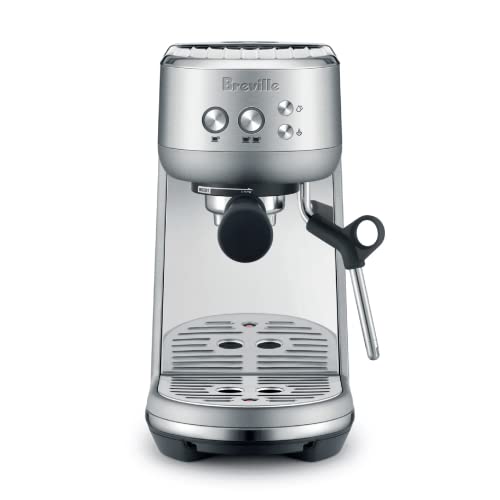
Breville Bambino
Breville lists PID, a ThermoJet heater ready in 3 seconds, low-pressure pre-infusion and a 54 mm portafilter dosed with 18 g, plus both single- and dual-wall baskets. At 7.7 in wide (Breville's listing) it is narrower than every other pick here except the Bambino Plus, which shares its body.
Buy it if: Straight espresso and the occasional flat white, with a grinder added now or later. Skip it if: You drink several milk drinks a day and want the wand to texture milk for you; that is the Bambino Plus.
- Type
- Semi-automatic
- Heating
- ThermoJet
- PID
- Yes
- Portafilter
- 54 mm
- Milk
- steam wand (manual milk texturing)
- Heat-up (maker)
- ready to start in 3 seconds
- Water tank
- 47 fl.oz
- Size (W×D×H)
- 7.7 x 12.6 x 12.2 in (W x D x H, Breville listing on Amazon)
- Weight
- 10.42 lb
Specs: Breville US product page (2026-11-09); Breville listing on Amazon (2026-11-09)
5. Budget machine with a grinder inside
CASABREWS Marenza
The Marenza adds an integrated conical burr grinder to a 58 mm, PID, thermoblock machine. CASABREWS's own pages disagree on the grinder (15 settings in the spec table, 30 in the description), so check the live listing.
Buy it if: One box, one plug, and a total spend near $300 with nothing else to buy. Skip it if: You want to upgrade the grinder later without replacing the machine.
- Type
- Semi-automatic
- Heating
- Thermoblock Heating System
- PID
- Yes
- Grinder
- integrated conical burr grinder; spec table: 15 Settings, bean hopper 6.35 oz / 180 g (product description and Amazon listing say 30 settings)
- Portafilter
- 58 mm
- Milk
- steam wand
- Water tank
- 57.49 oz / 1.7 L
- Size (W×D×H)
- 11.81'' x 8.9'' x 15.04''
- Weight
- 16.06 lb
Specs: CASABREWS US product page (2026-11-09); CASABREWS listing on Amazon (2026-11-09)
6. Stretch pick for milk drinks
Breville Bambino Plus
Same ThermoJet heater, PID and 54 mm portafilter as the Bambino, but the steam wand textures milk hands-free, and the tank grows to 64 fl oz. It sits at the top of the budget range.
Buy it if: Daily lattes and cappuccinos where you want to walk away while the milk steams. Skip it if: You drink espresso straight; the Bambino has the same brewing hardware for less.
- Type
- Semi-automatic
- Heating
- ThermoJet
- PID
- Yes
- Portafilter
- 54 mm
- Milk
- automatic steam wand (hands-free milk texturing)
- Heat-up (maker)
- ready to start in 3 seconds
- Water tank
- 64 fl.oz
- Size (W×D×H)
- 7.7 x 12.5 x 12.2 in (W x D x H, Breville listing on Amazon: 'a width of 7.7 inches')
- Weight
- 10.91 lb
Specs: Breville US product page (2026-11-09); Breville listing on Amazon (2026-11-09)




Product prices and availability are accurate as of 2026-11-13 and are subject to change. Amazon prices are for the colour linked. Specs are the makers' published figures; we don't test machines.
Does home espresso pay for itself?
Put in your own prices. The starting numbers are only an example to change.
Home cost per drink
$1.04
beans $0.74 + milk $0.30
Break-even
25 weeks
about 5.6 months
After 1 year / 2 years
$863 / $2,486
saved (negative = still paying off)
Café: spend after 26 / 52 / 104 weeks
26 wk: $1,001
52 wk: $2,002
104 wk: $4,004
Home: spend after 26 / 52 / 104 weeks
26 wk: $949
52 wk: $1,139
104 wk: $1,518
Not counted: electricity, water filters, descaler, repairs, the drinks you'd have skipped, or the value of your time. The calculation is simple arithmetic on your inputs, shown above.
Specs are each maker's published figures (source linked per machine). Amazon prices as of 2026-11-13; prices change. We earn from qualifying purchases; it never affects matching or order, which is lowest price first.
The price ladder, step by step
Read the table from the top to find the best budget espresso machine for the money you have. Each row is the cheapest point at which a feature appears in our catalogue, with the machines that bring it. The features that matter most for espresso itself are the basket type, the portafilter size and whether the maker states temperature control. Brand, finish and touch panels matter less than the price suggests.
| Price step | Machine | Heater (maker's term) | PID stated? | Portafilter | What the step adds |
|---|---|---|---|---|---|
| Under $120 | CASABREWS 3700 Essential | Thermoblock | Yes | 51 mm | PID and pre-infusion at the lowest price |
| $120 to $150 | CASABREWS CM5418 | Thermoblock single boiler | Yes | 51 mm | Built-in pressure gauge |
| $120 to $150 | Chefman CraftBrew | Not published | Not stated | Not published | Shot timer and a 1.5 L tank |
| Around $150 | De'Longhi Stilosa | Stainless steel boiler | Not stated | Not published | A boiler and a major maker's service network |
| Around $150 | De'Longhi Classic | Thermoblock | Not stated | Not published | Pressure gauge; ships with double-wall filters only |
| Around $160 | Flair Classic | None (manual lever, kettle water) | Not applicable | 40 mm | No electricity; a 9 bar gauge you watch yourself |
| Around $180 | CASABREWS 5418 PRO | Thermoblock | Yes | Not published | Maker claims a 5-second heat-up |
| Around $210 | CASABREWS Ultra | Thermoblock single boiler | Yes | 58 mm | Café-size portafilter, 4 brew temperatures |
| Around $300 | Breville Bambino | ThermoJet | Yes | 54 mm | Single- and dual-wall baskets, 3-second start |
| Around $300 | CASABREWS Marenza | Thermoblock | Yes | 58 mm | Built-in conical burr grinder |
| Around $400 | Ninja Luxe Café Mini | Not published | Not stated | Not published | Built-in grinder and scale for weight-based dosing |
| Around $500 | Breville Bambino Plus | ThermoJet | Yes | 54 mm | Hands-free milk texturing |
Where does cheap stop making real espresso?
Not at a price, but at two conditions: the coffee has to be ground fine and fresh, and the machine has to be able to build pressure against it. INEI, the Italian espresso institute, sets 7 g of coffee, water at 88 °C ± 2 and 9 bar ± 1 for 25 seconds ± 2.5 as its conditions for a certified single espresso. Any pump machine on this page can reach 9 bar. Whether it reaches it on your coffee depends on the basket.
Breville's own manual explains the split. Single-wall baskets are for freshly ground beans and let you change grind, dose and tamp to balance the shot. Dual-wall, or pressurised, baskets are for pre-ground coffee and regulate pressure themselves, so they work regardless of grind or freshness. That forgiveness is the reason most budget machines ship with them. It is also the ceiling: a pressurised basket makes a passable, foamy shot from supermarket coffee, but it hides the changes you make, so you cannot dial in.
So the honest line is this. A machine that only ships with pressurised baskets, like the De'Longhi Classic, will make espresso-style coffee from pre-ground beans. A machine that also includes single-wall baskets, like the Bambino, can make espresso by the standard's definition, once it is paired with a grinder that can go fine enough.
Budget for the grinder, not just the machine
If you plan to use single-wall baskets, the grinder decides more than the machine does. Baratza puts it plainly: small changes in grind size move a cup from sour to balanced or from bitter to sweet. A grinder needs fine steps in the espresso range, not just a setting labelled 'espresso'. Here is what grinder makers in our catalogue say their machines can do, with typical list prices:
- SHARDOR Conical Burr Espresso Grinder 2.0 (around $70): 40 mm conical burrs, 51 settings and a portafilter cradle, per SHARDOR's listing.
- HiBREW G5 (around $170): 48 mm conical burrs with stepless adjustment, sold as a single-dose grinder for espresso and filter.
- Baratza Encore ESP (around $200): 40 mm conical burrs; steps 1 to 20 are micro-steps for espresso and 21 to 40 are for filter.
- Breville Smart Grinder Pro (around $200): 60 settings and cradles for 50–54 mm and 58 mm portafilters, so it grinds straight into a Bambino's basket.
- Fellow Opus 2 (around $200): 48 mm conical burrs, stepless dial, a dosing cup sized for 54 mm and 58 mm portafilters.
- Avoid for espresso: the Fellow Ode Gen 2, which Fellow says 'is not intended for espresso', and the original Baratza Encore, which Baratza positions for filter brewing.
Pump labels: 15 bar, 20 bar, and the 9 bar that matters
Budget boxes print big numbers: 15 bar on the Stilosa and the Bambino's pump, 20 bar on every CASABREWS. These are pump ratings, the maximum the pump can push. Espresso is extracted at about 9 bar, which is what INEI and the heritage SCAA definition both specify. Breville's Barista Express manual calls its pump 'the 15 bar Italian pump' and its Dual Boiler manual treats a gauge 'not reaching 9 bars' as the fault to fix.
A 20-bar machine does not make stronger or better espresso than a 15-bar one. When you compare budget machines, skip the bar figure and look at the basket type, the portafilter size and whether temperature is controlled.
Do budget machines have PID?
More than you might expect. A PID controller adjusts the heater to keep brew temperature in a tighter range. Quick Mill, an Italian maker, notes that PID 'is not the only way a machine can achieve stable brewing conditions', so a missing PID is not a dealbreaker on its own. Still, among budget machines, the ones whose makers state PID are the CASABREWS 3700 Essential, CM5418, 5418 PRO, Ultra and Marenza, and Breville's Bambino and Bambino Plus. De'Longhi does not state it for the Stilosa or Classic, and Chefman publishes no heating details at all.
PID matters most if you buy beans from different roasters, since lighter roasts are often brewed hotter. The Ultra is the only budget machine here that lets you choose among four temperatures.
The Ultra and the Bambino show two different approaches. The Ultra lets you pick the temperature; the Bambino holds the one Breville set; its four buttons, as Breville lists them, include no temperature control. Neither is wrong. If you plan to buy one roast and stick with it, a fixed, controlled temperature is all you need.
Measure the counter before you order
Budget machines are not always small. Width is the number that decides whether a machine fits beside a kettle, and depth decides whether it fits under wall cabinets with the water tank lid open. The chart shows the widths the makers publish; the CASABREWS CM5418 and 3700 Essential are missing because CASABREWS lists their dimensions without saying which figure is width.
The Bambino's depth is 12.6 in and its height 12.2 in. The Ultra is 12.2 in deep and 12.9 in tall. If your cabinets sit about 18 in above the counter, check the height with the tank lid lifted, since most of these machines fill from the top.
Lattes on a budget: manual wand or hands-free?
Every electric machine here has a steam wand, and on most of them you texture the milk yourself. The Bambino's wand is manual. The De'Longhi Classic's wand has two modes, which De'Longhi calls a dual mode frother. The Bambino Plus is the cheapest machine in our catalogue with an automatic wand: Breville says it textures milk hands-free.
Machines with a single thermoblock or a small boiler switch between brew and steam temperature, so you pull the shot first and steam second. That is normal at this price. If you make several milk drinks back to back, the switching time adds up, and a hands-free wand at least frees your hands while you wait.
Is a budget machine worth it against café drinks?
If you drink espresso most days, even the best budget espresso machine has to earn its place against café drinks, and the answer depends on your numbers. The calculator below takes a setup cost (preset to $500, a Bambino plus a grinder) and your own café price and drinks per week, then shows when the machine pays for itself. Change the setup figure to match the price step you picked above.
Remember the running costs it asks for: beans, milk and the occasional descaler. Breville says to descale when the machine's indicator tells you to, rather than on a fixed calendar, and advises against distilled water.
Every page in this section
- Best Espresso Machine for Beginners
Best espresso machine for beginners, chosen in six steps: forgiving baskets, a grinder budget, push-button or manual, and makers' specs with live prices.
- Best Espresso Machines Under $1,000
Best espresso machine under 1000 dollars, picked from makers' spec sheets: built-in grinder or not, PID, 58 mm baskets, milk automation and live prices.
- Espresso Machines Under $200
Best espresso machine under 200 dollars, without the myths: why 20-bar labels mislead, what pressurised baskets do, and six picks with makers' published specs.
- Espresso Machines Under $500
Best espresso machine under 500 dollars, with the grinder counted: five ways to split $500, spec tables from makers' pages, and the 54 vs 58 mm question.
- De'Longhi Stilosa
DeLonghi Stilosa specs from De'Longhi's own page: single boiler, 15 bar pump, manual wand, no PID or size listed. What it can't do, and the rivals to weigh.
Questions people ask
- What is the cheapest espresso machine that makes real espresso?
- The cheapest machine in our catalogue whose maker states PID and a pump is the CASABREWS 3700 Essential, at around $110. For espresso by the INEI definition you also need fresh beans ground fine, so add a grinder; with pre-ground coffee, use the pressurised basket.
- Is the Breville Bambino worth the extra over a $150 machine?
- It adds three things the makers of most $150 machines do not publish: PID control, a 54 mm portafilter with both single- and dual-wall baskets, and a 3-second start (Breville's figure). If you plan to buy a grinder, those features let you dial in. If you will only ever use pre-ground coffee, the gap narrows.
- Can I use pre-ground coffee in a budget espresso machine?
- Yes, in a dual-wall (pressurised) basket. Breville says these baskets regulate pressure to help extraction regardless of grind or freshness. In a single-wall basket, pre-ground coffee usually runs too fast.
- Do I need a 20-bar machine?
- No. Espresso is extracted at about 9 bar under both the INEI and heritage SCAA definitions. A 15- or 20-bar figure is the pump's maximum rating.
- How much should I spend on a grinder for a budget machine?
- Espresso-capable grinders in our catalogue run from about $70 (SHARDOR) to about $200 (Baratza Encore ESP, Breville Smart Grinder Pro, Fellow Opus 2). Check that the maker names espresso as a use and offers fine steps in that range.
- Is a manual lever press a good budget option?
- It can be. The Flair Classic needs no electricity, has a gauge marked for 9 bar brewing and a 40 mm portafilter, and you heat the water in a kettle. It has no steam wand, so it suits straight espresso drinkers.
Sources & further reading
- Breville Bambino BES450 product page (2026-11-09)
- Breville Barista Express BES875 instruction book (baskets, pump rating; 2026-11-09)
- Breville Dual Boiler BES920 instruction book (9 bar fault, water advice; 2026-11-09)
- INEI, A Brief Guide to the Italian Certified Espresso (archive copy, read 2026-11-09)
- SCA 25 Magazine, Defining the Ever-Changing Espresso (2026-11-09)
- Quick Mill, Guide to choosing an espresso machine (PID; 2026-11-09)
- Baratza, Switching Grind Settings with Confidence (2026-11-09)
- De'Longhi Stilosa EC260BK US product page (2026-11-09)
- CASABREWS Ultra product page (2026-11-09)
- r/espresso thread: Best espresso machine for $300 or less (owner opinions)
Read next
- Espresso Machines Under $200
Best espresso machine under 200 dollars, without the myths: why 20-bar labels mislead, what pressurised baskets do, and six picks with makers' published specs.
- Espresso Machines Under $500
Best espresso machine under 500 dollars, with the grinder counted: five ways to split $500, spec tables from makers' pages, and the 54 vs 58 mm question.
- Best Espresso Machine for Beginners
Best espresso machine for beginners, chosen in six steps: forgiving baskets, a grinder budget, push-button or manual, and makers' specs with live prices.
- De'Longhi Stilosa
DeLonghi Stilosa specs from De'Longhi's own page: single boiler, 15 bar pump, manual wand, no PID or size listed. What it can't do, and the rivals to weigh.
- Espresso Grinders
Espresso grinder guide: 14 grinders sorted by what their makers say about espresso, with burr size, settings, stepless or stepped, and a machine matcher.
- Is Home Espresso Worth It?
Is home espresso worth it? Enter your café price, drinks per week and setup cost to see your cost per drink and break-even week. Worked example shown in full.
Back to the EspressoGoods home page.
EspressoGoods editors · Editorial team
EspressoGoods' catalogue and guides are compiled by the site's editorial team from espresso machine and grinder makers' own product pages, spec sheets and manuals, plus standards bodies such as the Istituto Nazionale Espresso Italiano. We do not test machines or taste shots, and we never claim to: every spec on the site links to the page it came from.
About this site · How pages are checked · Last updated November 8, 2026
As an Amazon Associate, EspressoGoods earns from qualifying purchases. It costs you nothing extra and never decides which machines we list.
EspressoGoods is an independent site. It is not affiliated with Breville, De'Longhi, Gaggia, Rancilio, Philips, Ninja or any other maker. Brand names and trademarks belong to their owners. Specs are the makers' published figures; check the maker's page before you buy.